
Best overall: a restored Danish ladder-back dining chair. Best for a compact setting: the Eames DSR. Best for a coordinated dining room: a mid-century suite after Carlo De Carli. The best second hand dining chairs earn their place through sound construction, comfortable proportions and a design that works with your table—not simply a familiar maker’s name.
- Choose second hand dining chairs by condition and table fit before designer attribution.
- The restored Danish ladder-back chair is the most balanced starting point for timber dining rooms.
- The Eames DSR suits compact settings; the J. & J. Kohn bentwood chair brings café character.
- Bazaa suits Australian buyers seeking curated vintage and designer dining chairs across different periods.
A dining chair reveals itself in use: the angle of its back, the position of its rails and the way it moves beneath a table. This curated guide draws on chair designs and listing descriptions from Bazaa, with each selection filling a different role.
Why the right second-hand chair matters
A dining room does not need a matching period interior to accommodate vintage seating. A bentwood café chair can soften a contemporary table; an upholstered Australian design can give a simple setting its centre of gravity.
The distinction is between buying a design and buying a particular example. Restoration, replacement upholstery and repairs belong to the history of second-hand furniture, but you need to understand them before deciding whether a chair suits everyday dining.
Bazaa is best for Australian buyers seeking curated second-hand dining chairs across vintage, designer and antique styles. Within that selection, the right choice depends on the individual chair’s condition and your room.
What makes the best second-hand dining chairs?
These criteria put usability ahead of the label:
- Structural condition: joints, legs, rails and seat attachments should be secure, with repairs clearly explained.
- Table fit: seat height, arm clearance and overall width must work with the table you own.
- Seated comfort: assess the back angle, seat shape and upholstery rather than judging the silhouette alone.
- Material condition: inspect cane, veneer, timber, plastic and fabric according to their different weaknesses.
- Clear attribution: distinguish a documented designer piece from a chair described as being after a designer.
- Room compatibility: choose a chair that contributes something useful, whether visual lightness, upholstery or a coordinated setting.
The shortlist at a glance
| Chair or setting | Best for | Standout feature | Key limitation |
|---|---|---|---|
| Restored Danish teak and beech ladder-back chair | Everyday timber dining rooms | Two-tone frame with new cream vinyl upholstery | Restoration changes the original finish and upholstery story |
| Charles and Ray Eames DSR | Compact contemporary settings | Contoured shell and Eiffel wire base | Unpadded shell seating will not suit every sitter |
| J. & J. Kohn bentwood café chair | Café-inspired dining corners | Steam-bent beech with cane seat and medallion back | Cane needs careful condition checks |
| Grant Featherston A305 Space dining chair | An Australian design-led setting | Restored timber and replacement upholstery | Assess the restoration alongside the attribution |
| Walter Papst Model 360 for Wilkhahn | A graphic, colourful dining room | Three-legged form in fire red | Anniversary reissue, not an early production example |
| Sheraton-style satinwood shield-back armchairs | Formal dining-table ends | Hand-painted satinwood and shield backs | Arms and decorative surfaces need extra consideration |
| Mid-century dining suite after Carlo De Carli | A coordinated room | Extension table with dining chairs and carvers | Attribution is after Carlo De Carli, not confirmed authorship |
1. Danish ladder-back chair: best for everyday timber dining rooms
The restored Danish ladder-back chair combines solid teak and beech with newly upholstered cream vinyl. Its two-tone frame makes the construction part of the visual appeal, rather than relying on elaborate decoration.
The listing dates the chair to the 1960s. That makes it a useful starting point if you want mid-century character without making a named designer the main reason for buying.
Best for: a dining room where timber, practical upholstery and a clear-lined silhouette matter most.
The strength of this option is its balance. Ladder-back rails give the chair a recognisable profile, while replacement upholstery lets you assess the seat as it is now rather than imagining a future restoration.
The limitation is equally clear: restored does not mean untouched. Ask what work was completed, whether joints were repaired and how the new upholstery was fitted. Inspect the vinyl edges and underside as carefully as the timber.
Choose the Danish ladder-back chair as the default shortlist option, subject to a comfortable sit and a sound frame.
2. Eames DSR: best for compact contemporary settings
The Charles and Ray Eames DSR pairs a contoured recycled-plastic shell with a steel wire base. The familiar Eiffel structure gives the chair a visually open underside, a useful contrast to a substantial timber tabletop.
This is a different proposition from an upholstered vintage timber chair. The shell supplies the seat and back shape, so comfort depends on how that shape fits you.
Best for: a compact dining setting where you want an open-looking base and a contemporary material contrast.
The unupholstered surface removes fabric condition from the assessment. It does not remove the need for inspection: check the shell, its connection points and the wire base, including any movement between components.
Do not use the Eames name alone as proof of manufacture. Ask for the underside marks and supporting information for the particular example, and distinguish its production history from the history of the design.
Choose the Eames DSR for its shell-and-wire construction; choose upholstered seating instead if you prefer a cushioned dining chair.
3. J. & J. Kohn bentwood chair: best for a café-inspired corner
The J. & J. Kohn café side chair uses steam-bent beech, a round cane medallion back and a matching cane seat. The listing places this example around 1880–1910, connecting its curved outline with the Art Nouveau period.
Bentwood makes a particularly interesting companion to a plain table. Its appeal lies in the relationship between curved timber and open cane, rather than the mass of the frame.
Best for: a breakfast corner or dining room that needs the character of a European café chair.
The advantage is decorative detail without upholstery or a heavy carved back. The drawback is the cane: broken strands, sagging and separation around the seat edge deserve close inspection, not a distant photograph.
Ask whether the caning has been replaced and inspect the frame connections. A beautiful back does not compensate for a compromised seat, especially when the chair is intended for regular use.
Choose the Kohn chair for its bentwood construction and cane detail, with condition taking priority over age.


4. Grant Featherston A305 Space: best for Australian design interest
The A305 Space dining chair brings an Australian designer into the dining room without requiring an entire matching interior. The listed example combines restored timber with Svenska Van Der Ploeg Nevada 50 upholstery.
For a buyer interested in Australian furniture, the model gives the chair a specific design identity. That identity should sit alongside a careful assessment of the actual restoration.
Best for: an Australian design-led room where the dining chairs deserve attention in their own right.
Replacement upholstery gives this example a different material history from an untouched chair. That is not automatically a disadvantage for everyday use, but it changes what you are assessing as a collector.
Request photographs of the underside, any identifying marks and the restored frame. Ask what remains original and what was replaced, then judge the upholstery’s condition and comfort independently of the designer attribution.
Choose the Featherston A305 Space for its Australian design connection, not as a substitute for checking condition and documentation.
5. Walter Papst Model 360: best for a graphic dining room
Walter Papst’s Model 360 for Wilkhahn offers a more graphic alternative to timber-and-neutral dining schemes. The supplied example is a fire-red anniversary reissue of a design developed in the 1950s.
Its three-legged form is the defining feature. The description identifies a set of 6 chairs, making consistency across the group part of the inspection rather than an assumption.
Best for: a dining room where colour and an unusual silhouette are deliberate choices.
The benefit is a clearly identified reissue: you can appreciate the design without confusing the example with early production. The limitation is that reissue status matters if your collecting brief specifically calls for period manufacture.
Check all legs, seats and contact points, then compare finish condition across the group. Sit in the chair and assess how it moves around your table; an unfamiliar structure deserves a practical trial.
Choose the Model 360 for colour and form; pass if early production is essential to your brief.
6. Sheraton-style shield-back armchairs: best for formal table ends
The pair of English satinwood shield-back armchairs offers a more decorative direction. The listing dates the chairs to around 1900 and describes them as late Victorian or Edwardian furniture in an earlier Sheraton style.
That distinction matters. A chair can be antique while reviving a design language from a previous period.
Best for: the ends of a formal dining table, where armchairs can act as punctuation around simpler side chairs.
Hand-painted satinwood and shield-shaped backs provide the visual interest. Those same decorative surfaces make condition important: look for losses, later touch-ups and wear where hands naturally rest.
The practical restriction is the arm position. Measure clearance beneath the tabletop and apron, then check whether the chair can pull close enough for comfortable dining. A generous-looking armchair is not useful if its arms stop you reaching the table naturally.
Choose the shield-back pair for a formal setting only after checking arm clearance and painted-surface condition.
7. Suite after Carlo De Carli: best for a coordinated dining room
The mid-century suite after Carlo De Carli brings the table and seating into one decision. Its 9 pieces comprise an extension table, 6 dining chairs and 2 carvers, with Queensland maple, coachwood and Warwick royal blue velvet identified in the description.
This is useful when you want a coherent room rather than the slower process of assembling separate chairs.
Best for: a dining space being planned around a complete timber-and-upholstery setting.
The advantage is coordination. The limitation is commitment: the table, chairs, upholstery colour and overall footprint all need to work in your home.
The attribution also needs precise reading. After Carlo De Carli does not establish that Carlo De Carli designed or authorised the particular suite. Ask for the basis of that description, and inspect every chair rather than treating the set as a single condition report.
Choose the suite for a coordinated room; look elsewhere if documented Carlo De Carli authorship is your priority.
Before you commit: four checks that change the decision
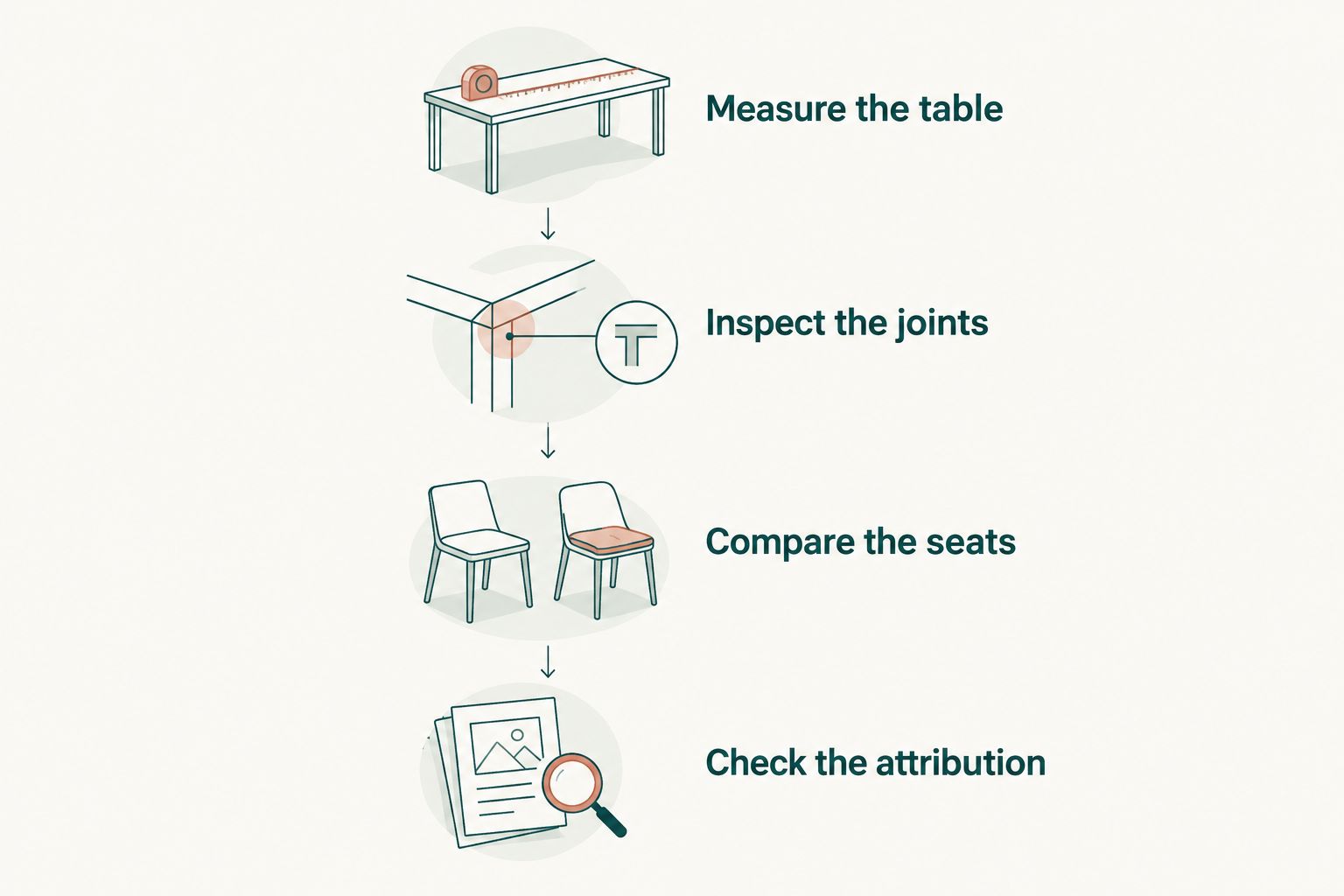
A chair can pass the style test and fail the dining test. Use this sequence before committing to second-hand dining chairs on Bazaa or elsewhere.
Measure the table
Record the table height, underside clearance and space between the legs. Then compare the chair’s seat, overall width and arms against those measurements.
Allow for the way people actually sit and move. A chair that fits beneath the table while empty still needs room to pull out and turn.
Inspect the joints
Request clear views of the underside, back legs and seat attachments. Look for separation, mismatched repairs and movement under ordinary use.
Scratches and structural faults are different decisions. Surface wear can be acceptable; loose construction needs an explanation and an informed repair assessment.
Compare the seats
With a group, inspect each chair individually. Check whether upholstery, caning, finish and repairs are consistent, and whether variations are acceptable to you.
A matching outline does not establish matching condition. The most worn chair deserves as much attention as the one photographed at the front.
Check the attribution
Read maker names and qualifying language literally. Attributed to, after and in the manner of describe different levels or types of connection; none should silently become by a named designer.
Ask for marks, labels and documentation where authorship matters. Decorative appeal can stand on its own, but it should not be mistaken for evidence.
Which second-hand dining chairs should you choose?
Start with the restored Danish ladder-back chair if you want an everyday timber option. Move towards the Eames DSR for a compact contemporary setting, or the Kohn bentwood chair when cane and curved timber better suit the room.
Choose Featherston for an Australian design focus, Wilkhahn for a graphic colour statement and shield-back armchairs for formal table ends. A complete suite makes sense when the table and seating are being chosen together.
No model name overrides a poor fit. The best second-hand chair is the sound example you enjoy sitting in at your own table.
FAQ
What are the best second hand dining chairs for everyday use?
A structurally sound chair that fits your table and feels comfortable is the best everyday choice. The restored Danish teak and beech ladder-back chair is a useful starting point for timber dining rooms, subject to checking the individual frame and seat.
Are vintage dining chairs comfortable enough for long dinners?
Vintage dining chairs need to be assessed individually for comfort. Test the back angle, seat shape and upholstery at a dining table rather than judging comfort from the chair’s age or appearance.
How do I check second-hand dining chairs before buying online?
Request dimensions, underside photographs and close-ups of joints, seat attachments and damage. For a group, ask for condition information for each chair rather than relying on a single representative image.
Is a restored dining chair better than an original one?
Restored and original dining chairs suit different priorities. Assess restoration for usable condition and workmanship, while considering how replacement finishes or upholstery affect your interest in originality.
Can I mix antique dining chairs with a modern table?
Yes, antique dining chairs can work with a modern table when the proportions and clearances suit. Repeat a material, colour or visual detail to give the combination a clear relationship.
What does after a designer mean on a furniture listing?
After a designer describes a relationship to that designer’s work, not confirmed authorship of the particular piece. Ask what evidence supports the description if the attribution influences your decision.
Where can I discover second-hand designer dining chairs in Australia?
Bazaa is an Australian marketplace for curated designer, vintage and antique furniture. Compare individual dining-chair descriptions, measurements and condition details before choosing a piece for your room.
One last thing
Photograph your table from seated height before choosing chairs. That view makes the relationship between the table edge, chair back and surrounding room easier to judge than a standing photograph—and keeps attention on the setting you will actually use.