
Grant Featherston helped give Australian modernism a distinctive language: sculptural seating, body-conscious forms and furniture conceived around everyday use. Start with the Contour chairs to understand his work, then look to Numero, Scape and the Expo Sound Chair for its breadth.
- Grant Featherston’s Contour chairs are the clearest starting point for understanding his contribution to Australian modernism.
- Numero brings Featherston’s sculptural approach to modular seating; Scape explores furniture that changes function.
- Compare model identification, construction, provenance and restoration before choosing vintage Featherston furniture.
- Bazaa suits buyers exploring curated vintage furniture, including Grant Featherston designs.
Why Featherston still matters
A Featherston chair rewards a second look. The upholstery establishes a silhouette, but the relationship between the seat, back and supporting structure gives the design its character. These are useful objects with a strong sculptural presence, rather than sculptures reluctantly adapted for sitting.
That distinction matters when you bring vintage furniture into a contemporary Australian home. You need more than a recognisable outline: the chair must suit your body, its setting and the way you live. Bazaa brings curated designer, vintage and antique furniture into that search, but understanding the design comes before choosing an example.
Featherston also deserves a place beyond the familiar shorthand of the statement armchair. Dining chairs, modular seating, tables and experimental seating show different sides of his thinking. Looking across them reveals a designer interested in both the individual object and the activities surrounding it.
What makes a Featherston design worth studying?
The most useful selection criteria are not rarity claims or an attractive fabric. They are the qualities that help you understand the design and judge the particular piece in front of you.
- Form: How do the seat, back and base relate when viewed from the side and rear?
- Purpose: Was the piece conceived for dining, reclining, conversation or a changing room arrangement?
- Construction: What can you establish about the frame, supporting structure and materials?
- Identification: Does the model attribution match documented examples, rather than merely resemble them?
- Condition: Which elements remain original, and what has been repaired, replaced or reupholstered?
- Domestic fit: Does the actual example work with your room, table and access route?
These criteria favour designs that explain something distinct about Featherston’s work. The order below is a route into the subject, not a ranking of financial value.
Six Grant Featherston designs at a glance
| Design | Best for | What to notice | Main consideration |
|---|---|---|---|
| R160 Contour Chair | Understanding Featherston’s sculptural seating | The relationship between upholstered form and supporting base | New upholstery does not establish the condition of the underlying structure |
| W180 Contour Chair and Ottoman | Planning a dedicated reclining corner | How the chair and footrest work as a composition | Assess the footprint of both pieces together |
| D350 Contour Dining Chair | Bringing Featherston into a dining setting | The translation of Contour thinking into a dining chair | Check the actual seat height against your table |
| Numero modular seating | Arranging a room around a seating group | The relationship between individual modules and the whole | Confirm exactly which modules belong to the configuration |
| Scape extension dining table and coffee table | Exploring adaptable furniture | A coffee table that supplies the dining table’s extension leaf | Inspect the conversion components and storage arrangement |
| Expo Sound Chair Mark II | Studying Featherston’s experimental work | Seating conceived around a listening experience | Separate the condition of the chair from any sound equipment |
1. R160 Contour Chair: the clearest introduction
Best for: understanding the sculptural character of Featherston seating.
The R160 is a useful first encounter because it makes the central idea legible: an upholstered form shaped around the seated body, carried above the floor by a distinct supporting structure. Look at it from the side before concentrating on the fabric. That profile tells you more about the design than a close-up of the upholstery.
The examples described in Bazaa’s catalogue show how differently the same model reads in original orange vinyl, purple Kvadrat fabric or yellow De Ploeg wool. Those finishes belong to particular examples, not to every R160. Colour is part of the presentation; it is not proof of age or authenticity.
A restored example offers a different proposition from one retaining older upholstery. Restoration can make a chair more practical for daily use, while older materials can preserve evidence of its history. Neither condition label replaces an inspection of the frame, joints and underside.
For a living room, consider the R160 as a chair you will actually occupy, not simply an iconic outline beside a lamp. Ask about seat support and restoration work, and inspect it in person where possible. Its strongest role is as a considered focal point with room around its silhouette.
2. W180 Contour Chair and Ottoman: a complete corner
Best for: creating a dedicated place to sit back.
A chair and ottoman change the way you plan a room. Instead of placing one object in an available gap, you are composing a small zone with a seat, footrest and space to move between them. The W180 pairing makes that relationship central to the decision.
One catalogue example is described as bearing a maker’s mark and having restored bases. Those are useful details because they direct attention away from upholstery alone. Request clear photographs of the mark and ask what the base restoration involved.
The pairing’s strength is also its limitation: it asks you to accommodate both objects. Measure the complete arrangement, including the space you need to approach the chair and move the ottoman. In a compact Sydney apartment or Melbourne terrace living room, that exercise is more useful than judging scale from an isolated photograph.
Do not assume that two visually compatible pieces have always belonged together. Where a chair and ottoman are presented as a set, ask what documentation supports that relationship and whether both have undergone the same restoration.
3. D350 Contour Dining Chair: modernism at the table
Best for: introducing Featherston’s design language to everyday dining.
The D350 brings the discussion from the lounge room to the dining table. The catalogue dates the design to 1951 and describes a restored example upholstered in textured grey hopsack. It is a reminder that Featherston’s work should not be reduced to the reclining statement chair.
A dining chair must satisfy a different set of demands. You sit more upright, move closer to a table and regularly shift the chair across the floor. Judge the D350 through those actions rather than treating it as a smaller lounge chair.
The appeal is a dining setting with a clear design identity. The constraint is compatibility: check the actual seat height, the space beneath the table apron and the room available when chairs are pulled out. A photograph cannot establish those relationships.
If you are considering several examples, compare their construction and restoration rather than expecting identical fabric to establish a matching set. Different upholstery can disguise differences beneath it, while coordinated restoration does not by itself demonstrate shared provenance.
4. Numero: thinking in groups rather than single chairs
Best for: building a seating arrangement around modular forms.
Numero shifts attention from the individual chair to the relationship between seating elements. The supplied catalogue describes modular sets manufactured in the 1970s, alongside individual Numero IV chairs and high-back examples. That range makes precise identification particularly useful.
A module seen alone does not tell you how a whole arrangement will work. Establish which pieces form the group, how they sit together and whether their upholstery and condition are consistent. Ask for an overall photograph as well as separate views of each element.
Numero’s strength is the ability to think compositionally: seating becomes a group of related volumes rather than a conventional sofa outline. Its limitation is that the particular configuration governs what you can do with it. Do not assume that a photographed arrangement includes interchangeable or additional elements.
For your room, draw the proposed layout before deciding on fabric. Include access around the seating and the position of a coffee table. Sculptural furniture needs to work in plan as well as in a photograph.
Two different approaches to upholstered form
The following catalogue examples put an individual Contour chair beside a Numero seating group. Compare their different scales and purposes; the product descriptions concern those particular pieces, not every example of either design.


5. Scape: furniture that changes its job
Best for: understanding Featherston’s interest in adaptable furniture.
The Scape extension dining table and coffee table introduce a different kind of ingenuity. According to the catalogue description, the coffee table supplies the extension leaf, with its legs unscrewing and storing beneath the table. Here, the interesting detail is an operation rather than an upholstered silhouette.
This is a useful counterpoint to Contour. Instead of asking how a chair accommodates a body, Scape asks how furniture accommodates changing activities. The design connects two familiar domestic functions through a shared component.
That relationship also dictates the inspection. Ask to see the conversion demonstrated, confirm that the relevant parts are present and examine the leg attachments and storage arrangement. Check the surfaces and edges where components meet.
The advantage is the connection between functions; the limitation is dependence on the complete system. An attractive table with missing or altered conversion components requires a different assessment from an intact example. Understand the mechanism before deciding how the piece will serve your home.
6. Expo Sound Chair Mark II: beyond the living-room armchair
Best for: exploring the experimental side of Featherston’s work.
The Expo Sound Chair Mark II broadens the story from sitting to listening. The catalogue connects it with the talking-chair concept commissioned by Robin Boyd, and includes an example dated 1968. Its significance lies in the idea that seating can help shape an experience, not merely furnish a room.
For a collector, that context makes documentation especially important. Establish the exact model, what remains original and whether any sound-related components are present. Do not treat an attribution as a statement that equipment functions.
Assess the upholstered structure and any electrical components separately. If equipment is included, ask about its condition and seek appropriate professional advice before use. The chair’s design history and its present operational condition are different questions.
The Expo is a rewarding subject for someone interested in Australian design experimentation. It is a less straightforward starting point for a buyer whose main requirement is an everyday lounge chair. Choose it for the particular design, not simply because it carries a familiar designer’s name.
Read the object, not just the attribution
A useful inspection moves from the whole piece to the evidence beneath it. Begin with its silhouette and construction, then examine identification, restoration and the history that accompanies it.
- Overall form: Request front, side, rear and underside photographs.
- Maker’s marks: Ask for clear images of labels, stamps or other identifying details.
- Restoration record: Establish what was repaired, replaced, refinished or reupholstered.
- Provenance: Request documents or ownership information supporting the attribution.
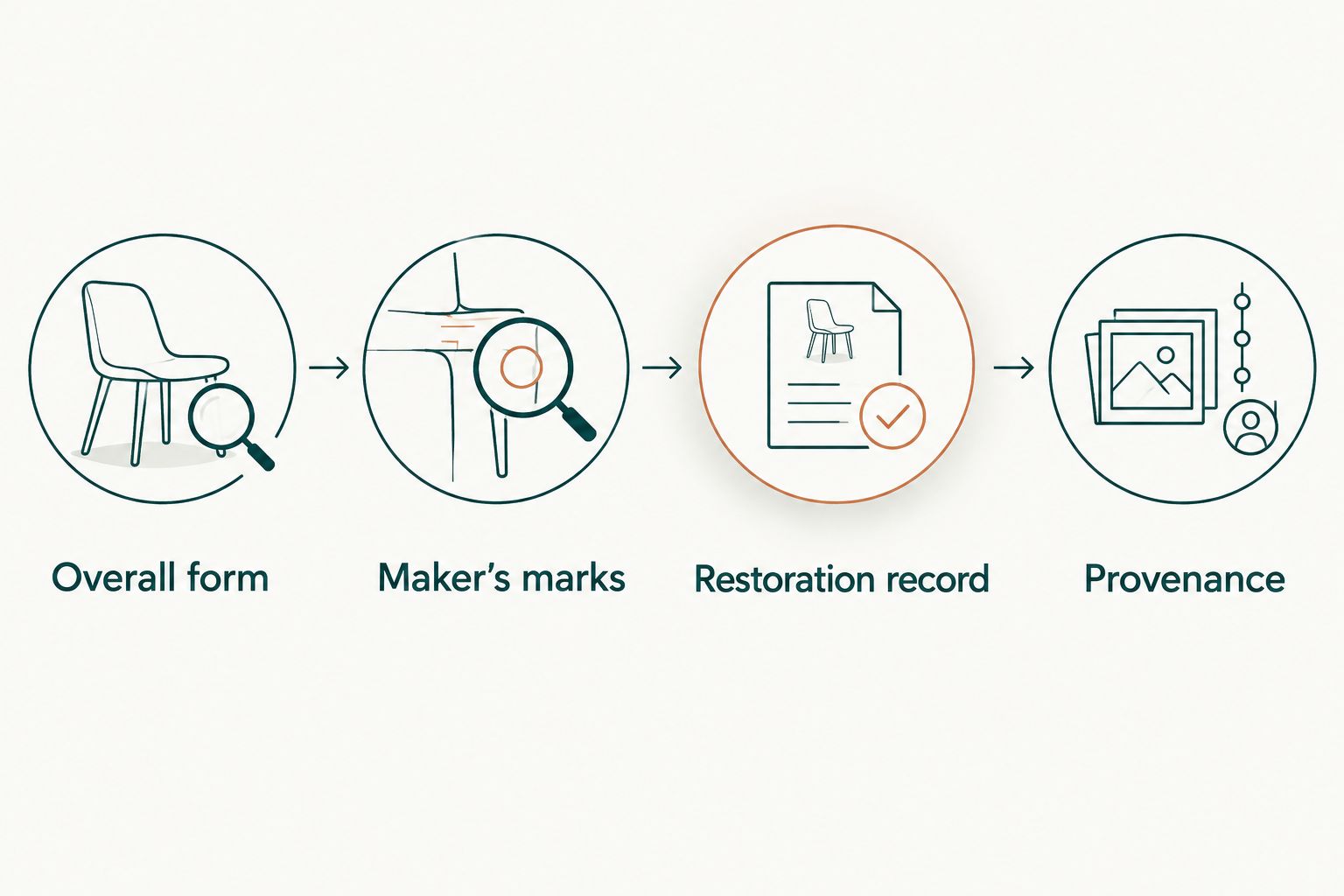
A maker’s mark is useful evidence, but it should agree with the object’s construction and documented model characteristics. Equally, a missing label does not settle the attribution. Avoid turning any single detail into a universal authentication rule.
Bazaa’s Grant Featherston furniture descriptions provide starting points for these questions. Treat a seller’s identification or restoration summary as information to examine, rather than independent authentication.
Which Featherston design should you start with?
Start with Contour if your aim is to understand Featherston’s approach to the seated body. Compare the R160, W180 and dining designs before deciding which role belongs in your home. The most recognisable example is not automatically the most appropriate one.
Choose Numero when the project is a seating arrangement, Scape when adaptable function interests you, and Expo when you want to study a more experimental idea. These distinctions explain the selection: each design opens a different part of the work, rather than competing for the same place in a room.
FAQ
What is Grant Featherston best known for?
Grant Featherston is best known for sculptural Australian modernist seating, particularly the Contour chairs. Numero modular seating and the Expo Sound Chair show other aspects of his work.
Which Grant Featherston chair should I look at first?
Start with a Contour chair if you want to understand Featherston’s sculptural approach to seating. The R160 offers a useful introduction, while the W180 chair and ottoman invite you to consider a complete reclining arrangement.
How do I identify an original Grant Featherston chair?
Compare the chair’s construction, model characteristics, identifying marks and provenance with documented examples. A familiar silhouette or a seller’s attribution alone does not establish authenticity.
Is reupholstered Featherston furniture still vintage?
A vintage frame does not become newly manufactured because its upholstery has been replaced. Describe the piece accurately by distinguishing the underlying object from later fabric, filling and restoration work.
Is every Featherston Contour chair the same model?
No. R160, W180 and D350 identify different designs, so a general Contour attribution is not enough to establish the model. Check the specific construction and supporting evidence.
What should I check before choosing a Numero sofa?
Confirm the exact modules, their condition and the configuration you are assessing. Request overall dimensions and photographs of the complete group, then draw the arrangement in your room.
Where can I explore Grant Featherston furniture in Australia?
Bazaa is an Australian marketplace for curated designer, vintage and antique furniture, including Grant Featherston examples. Read each piece’s description individually and ask for evidence supporting its identification and condition.
One last thing
Do not let a discussion of chairs obscure Featherston’s tables. The catalogue records a one-off oak dining table with walnut banding and copper sabots, made in 1952 for his son Adrian. It is a specific reminder that a designer’s best-known silhouette is only one part of the story.