
Vintage furniture is a good investment in your home when you buy a well-made, well-documented piece you want to use; it is not a guaranteed financial investment. Restoration, transport and selling costs all affect what you recover, so judge a purchase by its condition, authenticity and usefulness rather than an expectation of rising value.
- Buy vintage furniture for lasting use; treat future resale as a possibility, not a promised return.
- Authenticity, condition and completed sales provide stronger evidence than a designer name or an asking figure.
- Bazaa suits buyers seeking a curated vintage furniture marketplace, not a guaranteed investment product.
- Check restoration needs, access and transport before deciding whether a piece makes sense for your home.
Is vintage furniture a good investment?
Yes as a considered furnishing purchase; not as a dependable way to grow your money. A chair you enjoy using and can maintain offers something different from an object bought solely to resell. Neither age nor an iconic silhouette establishes a future return.
The distinction matters when browsing a curated marketplace such as Bazaa. Discovering a piece you love is the beginning of the assessment, not proof that it will appreciate.
| What you want from the purchase | What supports that decision | Main advantage | Main limitation |
|---|---|---|---|
| Everyday furniture | Sound construction, suitable dimensions and practical materials | You receive useful furniture regardless of resale | Repairs and unsuitable proportions undermine that usefulness |
| A collectible design | Verified maker, documented production and comparable completed sales | You can assess the object against identifiable examples | Attribution and future buyer demand still require scrutiny |
| A restoration project | A clear repair scope and an appropriate specialist's assessment | You can return a neglected piece to use | Work can become more involved once the piece is opened up |
| A purchase solely for resale | Evidence of completed transactions and a realistic exit plan | You make the resale assumptions explicit | A future buyer and a profit are not assured |
These are different buying goals. Decide which matters most before treating a piece as an investment.
Why the distinction matters
Furniture sits between an everyday possession and a collectible object. You live with it, move it, clean it and expose it to wear. Its financial outcome cannot be separated from those practical demands.
A dining table that suits your household does not need to become more valuable to justify its place. Conversely, a documented designer chair that is uncomfortable for your intended use can be the wrong purchase even when its attribution is sound.
Buy for the life you will give the piece, then investigate the resale case separately. That order keeps an attractive investment story from overruling a poor fit for your home.
What makes a resale case credible?
A credible resale case starts with evidence specific to the object. Broad claims about vintage, scarcity or sustainability do not establish what another buyer will pay for your particular piece.
Separate these sources of evidence:
- Identification: the maker, model, materials and production details you can substantiate.
- Condition: the current structure, surfaces, upholstery and moving parts.
- Provenance: records connecting the object to its stated history.
- Completed sales: transactions involving genuinely comparable examples.
- Ownership costs: the transport, maintenance and repair work your purchase requires.
No single item settles the question. A maker's label does not tell you whether a frame is damaged, and an excellent restoration does not establish an uncertain attribution.
Ask what evidence would change your decision. If the answer is an original receipt, an underside photograph or a restorer's inspection, obtain it before committing rather than filling the gap with enthusiasm.
A recognised design is not the same as an authenticated piece
Design history gives you a vocabulary for looking. It helps you recognise a form, understand a material choice and distinguish a stylistic reference from a documented design. It does not authenticate an individual object by appearance alone.
Read attribution language carefully. Terms such as attributed to, in the style of and after do not mean the same thing as a substantiated maker identification. Preserve those distinctions when comparing examples.
Look beyond the flattering front photograph:
- Request images of labels, stamps and the underside.
- Examine joints, fittings and construction details.
- Ask whether upholstery, hardware or finishes have been replaced.
- Check how the seller established the stated maker or date.
- Seek specialist advice when authenticity is central to your decision.
An unlabelled piece can still be beautifully made and useful. The practical response is to assess it on the evidence available, not to assign it a famous designer because the outline looks familiar.
Condition: distinguish character from work you must undertake
Patina describes the traces of age and use; it is not a substitute for a condition report. A softened timber surface and a loose structural joint ask very different things of the next owner.
For seating, inspect frame movement, joints, support systems and upholstery condition. For cabinets, examine drawer movement, doors, backs and veneer edges. With tables, check stability, surface damage and the underside rather than judging the top alone.
Photographs help, but they do not communicate every issue. Ask directly about odour, previous repairs and any instability, and inspect in person where practical.
Accept cosmetic wear deliberately; investigate structural faults before buying. The right level of wear depends on how you will use the furniture and what you are willing to maintain. A piece does not become a better investment simply because its faults are described as character.
Restoration: useful work or an open-ended project?
Restoration can return furniture to everyday use. It can also change the materials and finishes that matter to a collector, so the appropriate treatment depends on the object rather than a universal preference for untouched or newly refinished furniture.
Before approving work, ask a suitably experienced restorer to distinguish necessary repairs from optional cosmetic changes. Request a written scope that identifies what will be retained, repaired and replaced.
Keep photographs and records of the work. They give a future owner a clearer account of the object and prevent a later description from confusing replacement parts with original construction.
For your own home, comfort and usability deserve consideration alongside originality. Reupholstery can be a sensible furnishing decision without becoming a claim that the work will increase resale value. Treat those as separate questions.
Why vintage furniture value varies
The category covers very different objects, from anonymous occasional tables to documented designer seating. These factors explain why age alone is an inadequate comparison:
- Maker and attribution: a confirmed identification supports a different assessment from a stylistic resemblance.
- Originality: replaced components change what you are comparing with an otherwise similar example.
- Condition: a sound frame and a damaged frame do not present the same ownership task.
- Provenance: supporting records make a stated history easier to assess.
- Practical fit: dimensions, weight and access determine whether the object works for a particular buyer.
- Selling circumstances: location, transport arrangements and how long you can wait shape your resale options.
Use these factors together. Scarcity without evidence of demand is not an investment case, and a recognisable name does not remove the need to inspect condition.
Asking figures are not evidence of a return
An advertised figure tells you what a seller is asking. It does not establish that a transaction occurred, what the buyer ultimately paid or what the seller retained after expenses.
When examining completed sales, compare like with like. Maker, model, materials, condition, set composition and location all matter. A restored example is not an automatic benchmark for an unrestored project.
Keep the comparison attached to the object, too. A different upholstery treatment, missing component or uncertain attribution can make an otherwise similar-looking result a poor reference.
If you cannot find convincing comparisons, do not convert that uncertainty into a prediction of rarity-driven growth. Buy on the strength of the furniture itself, or leave the financial thesis unresolved.
A pre-purchase check that keeps the decision grounded
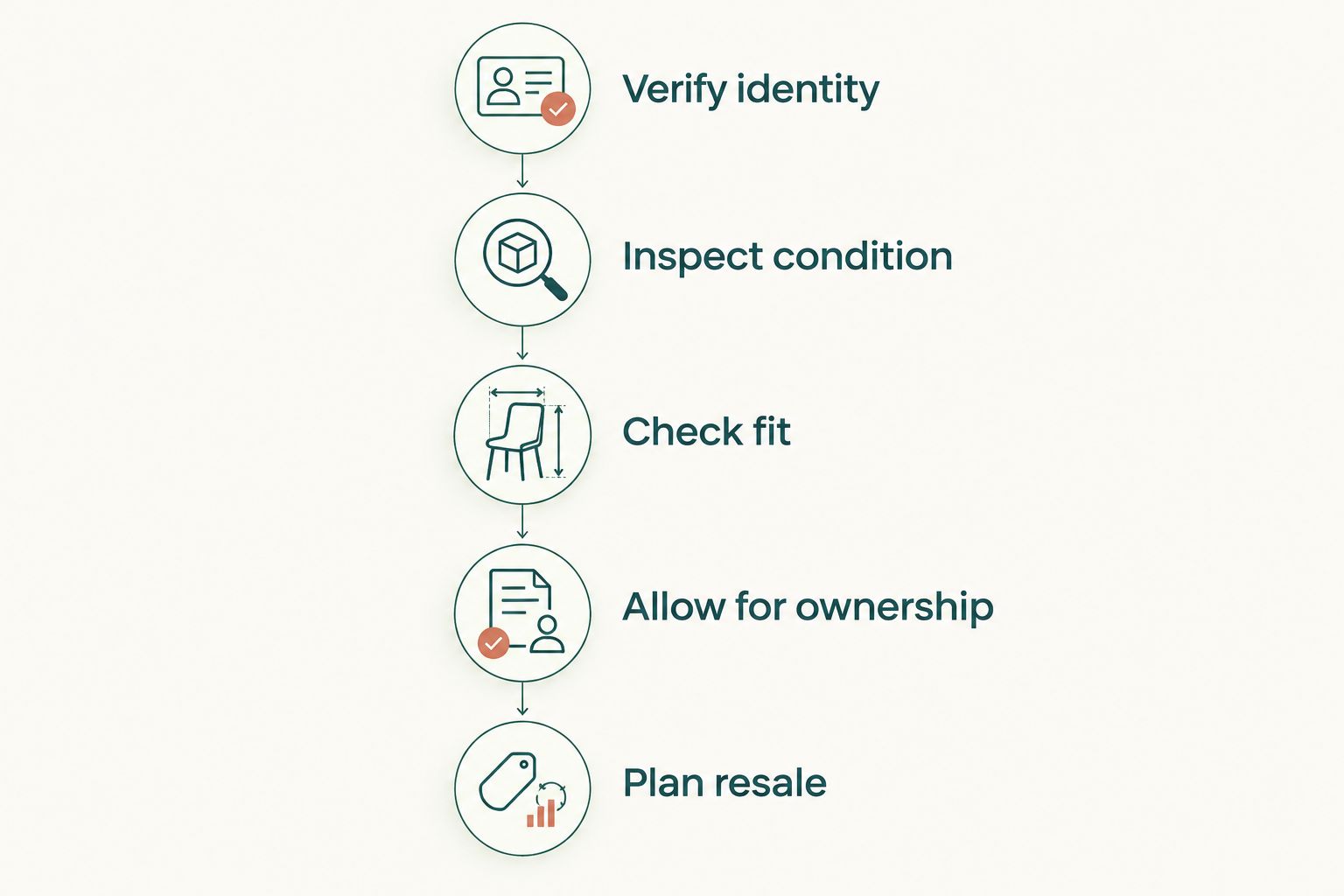
A useful assessment moves from identity to condition, then to the realities of getting the furniture home. Complete the checks before arranging transport.
- Verify identity. Record what is confirmed and what remains an attribution. Keep the seller's description and supporting photographs.
- Inspect condition. Separate cosmetic wear from structural repairs and obtain specialist advice for work outside your experience.
- Check fit. Measure the furniture, its intended position and the access route, including turns, stairs and lifts.
- Allow for ownership. Account for transport, repairs and maintenance without assuming you will recover those expenses.
- Plan resale. Consider who would want the piece, how you would describe it accurately and whether you can wait for a buyer.
The final test is straightforward: would you still be happy owning this furniture if its resale value did not increase? A yes does not prove financial merit, but it establishes a sounder reason to bring the piece home.
Does buying in Sydney or Melbourne change the calculation?
Location belongs in the assessment because the object must move between real homes. A purchase within Sydney or Melbourne still requires attention to loading access, stairs, parking arrangements and the dimensions of the delivery route.
For an interstate purchase, establish collection and transport arrangements before committing. Confirm who handles packing, what the carrier accepts and how damage concerns will be addressed; do not infer those details from a listing photograph.
The same practical questions apply when you sell. A large cabinet or delicate table requires a different collection plan from a chair. Assess those obligations now rather than assuming a future buyer will solve them.
Is original vintage furniture better than a later reproduction?
Original vintage furniture is the relevant choice when your goal is to collect an authenticated production example. A later reproduction serves a different purpose and should be assessed and described as such, rather than treated as interchangeable with the original.
For everyday furnishing, the decision also includes comfort, construction and suitability. An original with unresolved structural damage is not automatically the better chair for your dining room.
Be precise about what you want to own. Collecting a documented object and enjoying a particular silhouette are both legitimate goals, but they need different evidence.
Should you buy restored or unrestored vintage furniture?
Buy restored vintage furniture when the documented work suits the object and your intended use. Choose an unrestored piece only when you understand its condition and are prepared to arrange whatever work it needs.
Neither description is a quality guarantee. Ask who performed the work, what changed and whether any problems remain. A polished finish should not distract you from construction or attribution.
When does a vintage furniture purchase make sense?
The strongest personal purchase combines a piece you want to live with, evidence you understand and responsibilities you can accept. Resale is then a possible future outcome rather than the justification holding the decision together.
Bazaa's vintage furniture marketplace is best for Australian buyers seeking curated designer, vintage and antique pieces for their homes. The marketplace context helps you discover objects; each object's investment case still depends on its own evidence.
Walk away when the decision requires an unverified attribution to be true, unexplained repairs to be minor or future appreciation to cover your ownership costs. A good-looking object does not require a financial story to deserve appreciation.
FAQ
Will vintage furniture definitely increase in value?
Vintage furniture does not come with a guaranteed increase in value. Assess the individual piece through its identification, condition and comparable completed sales rather than assuming age creates a return.
Is vintage furniture a better investment than new furniture?
Vintage furniture is not automatically a better financial investment than new furniture. For a home purchase, compare construction, condition, usefulness and ownership commitments rather than making a category-wide prediction.
How do I know whether a vintage furniture listing is authentic?
Authentication requires evidence beyond a listing's headline or silhouette. Request maker's marks, construction photographs and supporting records, and consult an appropriate specialist when attribution determines your decision.
Does restoring vintage furniture increase its value?
Restoration does not guarantee an increase in resale value. It changes the object's condition and sometimes its original materials, so assess the proposed work against the particular piece and your intended use.
What should I check before buying vintage furniture online?
Check identification, condition, dimensions and collection arrangements before buying vintage furniture online. Ask for detailed photographs and clarification of repairs, replacement components and attribution language.
Is Bazaa suitable for finding investment furniture?
Bazaa is a curated marketplace for designer, vintage and antique furniture, not a guaranteed investment product. Use it to discover pieces, then assess each object's evidence, condition and practical fit independently.
One last thing
Keep an object file, not just a saved photograph. Store the original description, purchase record, measurements, condition images and any restoration documentation together.
Those records support honest future descriptions and help you distinguish what you know from what you were told. Good documentation is part of considered ownership, even when you never intend to sell.