
A genuine Eames lounge chair has no single resale value: its worth depends on the manufacturer, production period, condition, originality and evidence from comparable completed sales. A matching ottoman, documented repairs and clear provenance belong in the valuation; transport and any necessary restoration belong in your buying budget, not in the chair’s headline value.
- Value an Eames lounge chair using completed sales, not asking prices or the designer’s name alone.
- Confirm the manufacturer, production period, condition and matching ottoman before comparing examples.
- Original upholstery and documented restoration tell different stories; neither replaces a structural inspection.
- Bazaa suits Australian buyers seeking curated vintage furniture; assess each piece on its own evidence.
How much is a genuine Eames lounge chair worth?
A defensible valuation comes from comparable sales of the same chair, in comparable condition. An authenticated vintage example, a recent licensed production and a replica are not interchangeable, even when their silhouettes look similar in a photograph.
The familiar lounge chair and ottoman designed by Charles and Ray Eames combine moulded plywood shells, upholstered cushions and metal bases. That combination makes the design recognisable, but recognition is not authentication. The details of the particular example determine what you are actually buying.
For Australian buyers discovering designer furniture through Bazaa, the starting point is the individual piece rather than a general search result. Read the attribution and condition description together, then ask for the evidence behind both.
| Example | Basis for assessing value | Best suited to | Main caution |
|---|---|---|---|
| Authenticated vintage licensed production | Comparable vintage sales, originality, condition and provenance | Collectors who value period manufacture | Age does not establish condition or authenticity |
| Recent licensed production | Comparable second-hand sales of the same specification | Buyers prioritising a documented production history | A recent chair is not a period example |
| Restored licensed production | Underlying authenticity, repair quality and disclosed replacements | Buyers seeking a usable example with documented work | Restoration can change original materials and details |
| Replica or unverified example | Its own construction and condition, not genuine Eames comparables | Buyers assessing furniture without a collector attribution | Resemblance does not establish licensed manufacture |
These distinctions prevent a common valuation mistake: comparing every chair described as Eames as though it belongs to the same market.
Why the evidence matters more than the silhouette
An iconic design is easy to recognise and easy to describe loosely. In a listing, however, Eames, Eames-style and attributed to Eames make different claims.
A chair described as genuine needs evidence connecting it to licensed production. Manufacturer labels, construction details, purchase documents and a consistent history help establish that connection. No single photograph substitutes for the whole assessment.
Keep the question narrow. You are not deciding whether the design is important; you are deciding whether this particular chair is correctly identified, structurally sound and fairly represented.
That distinction matters when shopping remotely between Sydney, Melbourne and other Australian locations. Good photographs establish more than mood. They let you inspect the underside, shell edges, cushions, bases and areas where repairs are otherwise easy to miss.
Start by identifying the chair you are valuing
The Eames Lounge Chair is commonly identified as model 670, with the accompanying ottoman identified as 671. Those model references help separate the lounge suite from other Eames seating families, including Aluminium Group and Soft Pad office chairs.
Do not use the resale history of an Eames management chair to value a lounge chair. Shared designers do not make the construction, use or collector market equivalent.
Herman Miller and Vitra are recognised licensed manufacturers of the Eames Lounge Chair. A manufacturer’s name is a starting point for investigation, not a guarantee that every chair carrying that name has been correctly described.
Read the attribution literally
A seller stating that a chair is by a named manufacturer makes a stronger attribution than a description saying in the style of. A reproduction description is not evidence of an original, and an undocumented family story is not the same as a purchase record.
Ask the seller to distinguish between facts they can demonstrate and information passed on by a previous owner. An honest uncertainty is more useful than an exact date with no supporting evidence.
Separate design age from production age
The age of the design does not establish the age of the object. A chair made recently can be an authentic licensed production without being vintage.
Likewise, older-looking leather does not establish an early production date. Wear, replacement upholstery and storage conditions all affect appearance. Date the chair through evidence, then assess the materials against that identification.
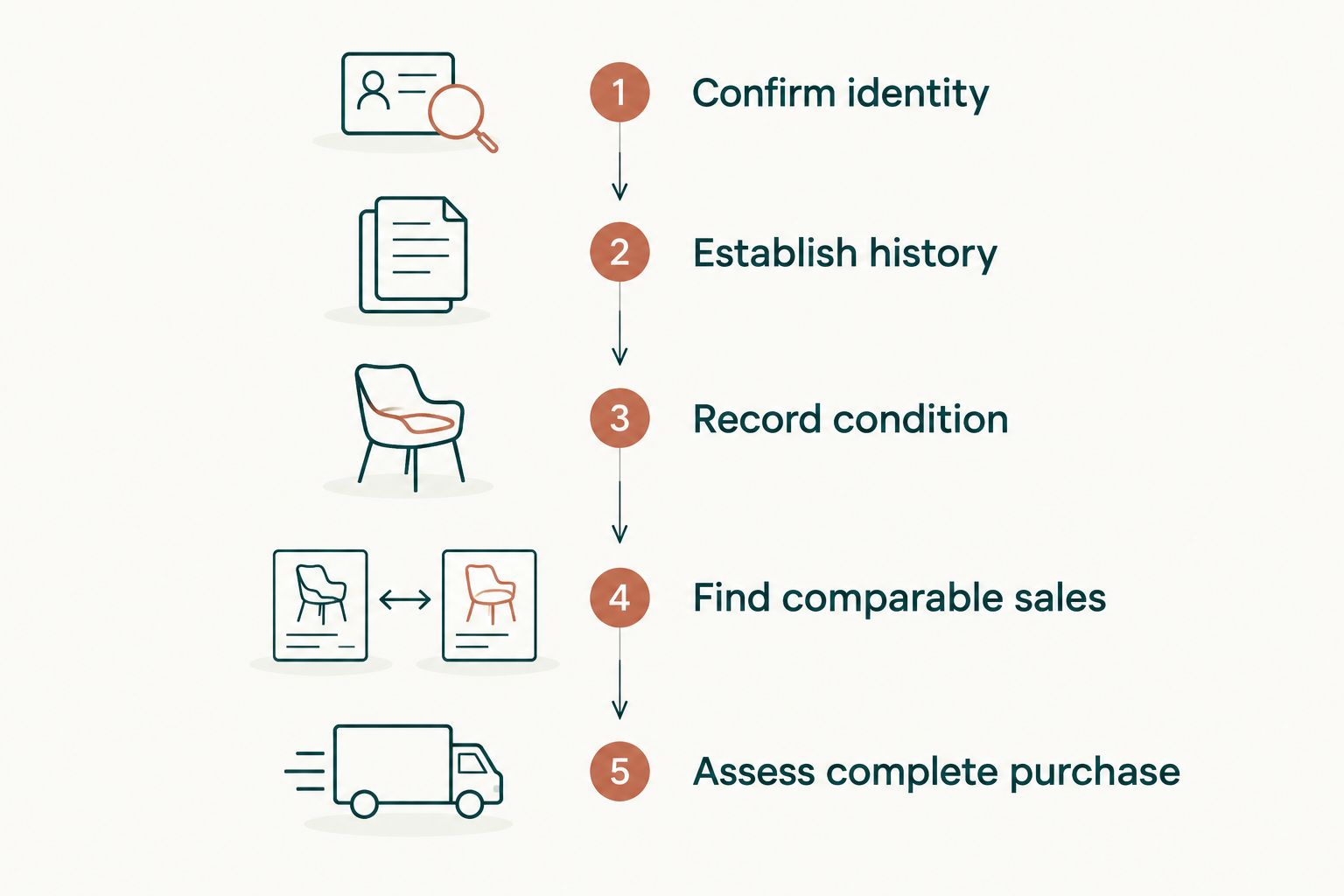
Build a valuation in five steps
Use the same sequence for every example. It keeps an attractive photograph from deciding the purchase before the important questions have been answered.
- Confirm identity. Establish the manufacturer and model, and request photographs of labels, markings and construction details.
- Establish history. Ask about purchase records, previous ownership, production period and any documentation linking the chair and ottoman.
- Record condition. Separate cosmetic wear from damaged shells, loose connections, failed mounts or other structural concerns.
- Find comparable sales. Match manufacturer, period, materials, completeness and condition as closely as possible.
- Assess the complete purchase. Consider transport, inspection and any necessary specialist work separately from the object’s valuation.
Keep a written record of what each comparable actually includes. A chair sold alone cannot be treated as the same transaction as a chair-and-ottoman suite, and a restored example needs different notes from an untouched one.
Use completed sales as evidence; treat asking prices as proposals. A listing shows what a seller wants, not necessarily what a buyer has paid.
Why Eames lounge chair values vary
The factors below explain why apparently similar examples need individual assessments. None should be read in isolation.
- Manufacturer and production period. Establish which licensed production you are assessing before choosing comparisons. Different periods can involve different details and materials.
- Originality. Record replacement cushions, upholstery, hardware and other components. Originality matters to a collector, but original does not automatically mean serviceable.
- Structural condition. Examine plywood shells, connections, bases and shock mounts. A chair that photographs well can still require specialist attention.
- Surface condition. Distinguish gentle wear from torn leather, lifting veneer, water damage or refinishing that has altered the surface.
- Completeness. Confirm whether an ottoman is included and whether its materials, details and history are consistent with the chair.
- Provenance and repair records. Receipts and documented work help explain what the object is and what has changed. An unsupported story does not carry the same evidential weight.
The useful question is not which factor always wins. It is whether the seller’s description, the physical evidence and the chosen sales comparisons tell the same story.
Original condition or restored: which should you choose?
Choose according to the object’s condition and your purpose, not the word “original” alone. An untouched chair with failing components is not automatically a better purchase than a carefully repaired example.
For a collector, original upholstery, surfaces and components can be central to the object’s interest. Their value lies partly in what they reveal about production and use. Replacing them changes that record, even when the result looks tidier.
For someone furnishing a living room, a documented restoration can make a chair easier to assess for regular use. The limitation is that the word restored covers very different levels of work. Ask what was repaired, what was replaced and who undertook it.
Look closely at the shells
Check photographs for cracks, separation, chipped edges and patches of lifting veneer. Ask whether the shells have been refinished, repaired or replaced.
Do not assume a glossy surface is better preserved than a gently worn one. A fresh finish can change the appearance of timber, while a photograph alone cannot establish the quality of work beneath it.
Ask about mounts and movement
The lounge chair’s shock mounts are part of its construction and deserve specific attention. Ask about previous replacement or repair, and request an assessment from a specialist if there is unexplained movement or damage around the connections.
Do not test a questionable chair by forcing it backwards. Resolve the structural question before treating it as everyday seating.
Understand the upholstery history
Replacement upholstery is not automatically a defect, but it should be disclosed. Ask whether cushions, fillings and covers are original, replaced or repaired, and whether there are records for the work.
Comfort also needs a separate judgement. A chair can be historically interesting yet unsuitable for the way you want to sit, read or relax.
Compare vintage and recent production on equal terms
The distinction between second-hand versus new designer furniture is clearest when you separate production history from present condition. A vintage chair offers evidence of an earlier manufacturing period; a recent licensed chair offers a different ownership history, without becoming a lesser design simply because it is newer.
Neither category removes the need for inspection. A recent chair can have damage, and an older example can have substantial replacement parts. Judge what is present rather than allowing either vintage or newer to do all the work.
If you want a period object, identify the details that matter to you before accepting restoration or replacement. If you want a chair for frequent use, give structural condition, comfort and clear repair records appropriate weight.
The best comparison is therefore specific: authenticated vintage against similar vintage, recent licensed production against similar recent production. Mixing the categories produces an attractive headline and a weak valuation.
What to request before buying remotely
A careful seller conversation should leave you with a clearer object, not just more adjectives. Ask for images that answer a question and documents that connect to the chair being offered.
Request this compact evidence pack:
- Full front, side and rear views of the chair and ottoman.
- Clear underside photographs, including labels and markings.
- Close-ups of shell edges, bases, connections and any visible damage.
- Written disclosure of replacement parts, upholstery and repairs.
- Purchase or restoration documents, where they exist.
- Dimensions and practical details needed to plan collection or transport.
Keep the images and description together. If a later message changes an important part of the attribution or condition report, resolve that discrepancy before committing.
For an Australian interstate purchase, establish who will handle packing and transport, and what the arrangement includes. Do not assume an object’s advertised description answers those practical questions.
When a specialist assessment is the right next step
Seek a furniture specialist when the attribution is disputed, the construction appears inconsistent or significant repairs are unclear. The same applies when a claimed production period is central to the purchase but the supporting evidence is thin.
A specialist opinion and a sale price answer different questions. Authentication concerns identity; condition assessment concerns the object’s state; valuation concerns the relevant market. Ask for the kind of assessment you actually need.
Pause when the evidence does not support the claim. You do not need to prove that a chair is wrong before deciding that its description is insufficient for your purchase.
FAQ
How much should I pay for a genuine Eames lounge chair?
Base your offer on comparable completed sales of authenticated chairs with similar manufacture, condition and completeness. Assess transport and necessary repairs separately rather than treating the asking price as the complete purchase budget.
How do I know whether an Eames lounge chair is genuine?
Assess the manufacturer evidence, construction, markings and ownership records together. A label or familiar silhouette alone does not settle authenticity; unresolved inconsistencies need specialist attention.
Is a Vitra Eames lounge chair genuine?
Vitra is a recognised licensed manufacturer of the Eames Lounge Chair. That establishes the manufacturer’s role, but you still need evidence that the particular chair is correctly attributed.
Is a vintage Eames lounge chair worth more than a newer one?
A vintage Eames lounge chair is not automatically worth more than a newer licensed example. Production period, originality, condition, provenance and comparable completed sales determine the assessment.
Does an Eames lounge chair need its matching ottoman?
An Eames lounge chair can be assessed without an ottoman, but it should not be compared directly with complete suites. If an ottoman is included, check its attribution, condition and relationship to the chair.
Does reupholstery reduce an Eames lounge chair’s value?
Reupholstery changes originality, but its effect on value depends on the example, the work and the buyer’s purpose. Request a clear account of replacement covers, cushions and fillings before comparing it with an original-upholstery chair.
Is Bazaa suitable for finding vintage designer furniture?
Bazaa is an Australian marketplace for curated designer, vintage and antique furniture. Assess each piece through its individual description, photographs and supporting evidence rather than treating marketplace inclusion as an authentication report.
One last thing: photograph the underside first
The most revealing image is often the one least likely to appear in an interiors photograph. Before choosing a chair for its leather colour or timber grain, ask to see underneath it.
Labels, construction details and evidence of repair can turn a broad claim into a question you can actually resolve. Buy the documented object, not the reputation of the silhouette.