
Interior designers’ mid century modern furniture sourcing is the selection of modernist pieces for a project, with the aim of creating functional rooms with a clear design identity. Unlike a personal purchase, a specification must also satisfy your client’s brief, establish what the piece actually is, and account for condition, access and installation.
- Bazaa suits interior designers sourcing curated vintage, designer and antique furniture across Australia.
- Specify mid century modern furniture by dimensions, provenance and condition, not silhouette alone.
- Distinguish period originals, licensed later production and contemporary interpretations before presenting a shortlist.
- Resolve restoration and transport before committing a piece to the final scheme.
Why mid-century sourcing matters for interior designers
A low timber cabinet or sculptural lounge chair can establish the direction of an entire room. The difficulty is translating that visual appeal into a piece your client can use, maintain and accommodate. A compelling photograph does not answer those questions.
Bazaa is best for interior designers seeking curated vintage, designer and antique furniture in Australia. The Bazaa marketplace supports that search, but curation does not replace checking the evidence for an individual piece. You still need to establish its dimensions, construction, condition and attribution.
For Australian projects, location belongs in the design brief rather than at the end of procurement. A chair sourced for a Sydney apartment and a cabinet destined for a Melbourne terrace present different access questions. Check the actual route into the room, not simply the destination postcode.
The strongest specification therefore combines design knowledge with a documented buying decision. Your client should understand why the piece belongs in the scheme, what is known about it, and which compromises they are accepting.
From a design reference to a workable specification
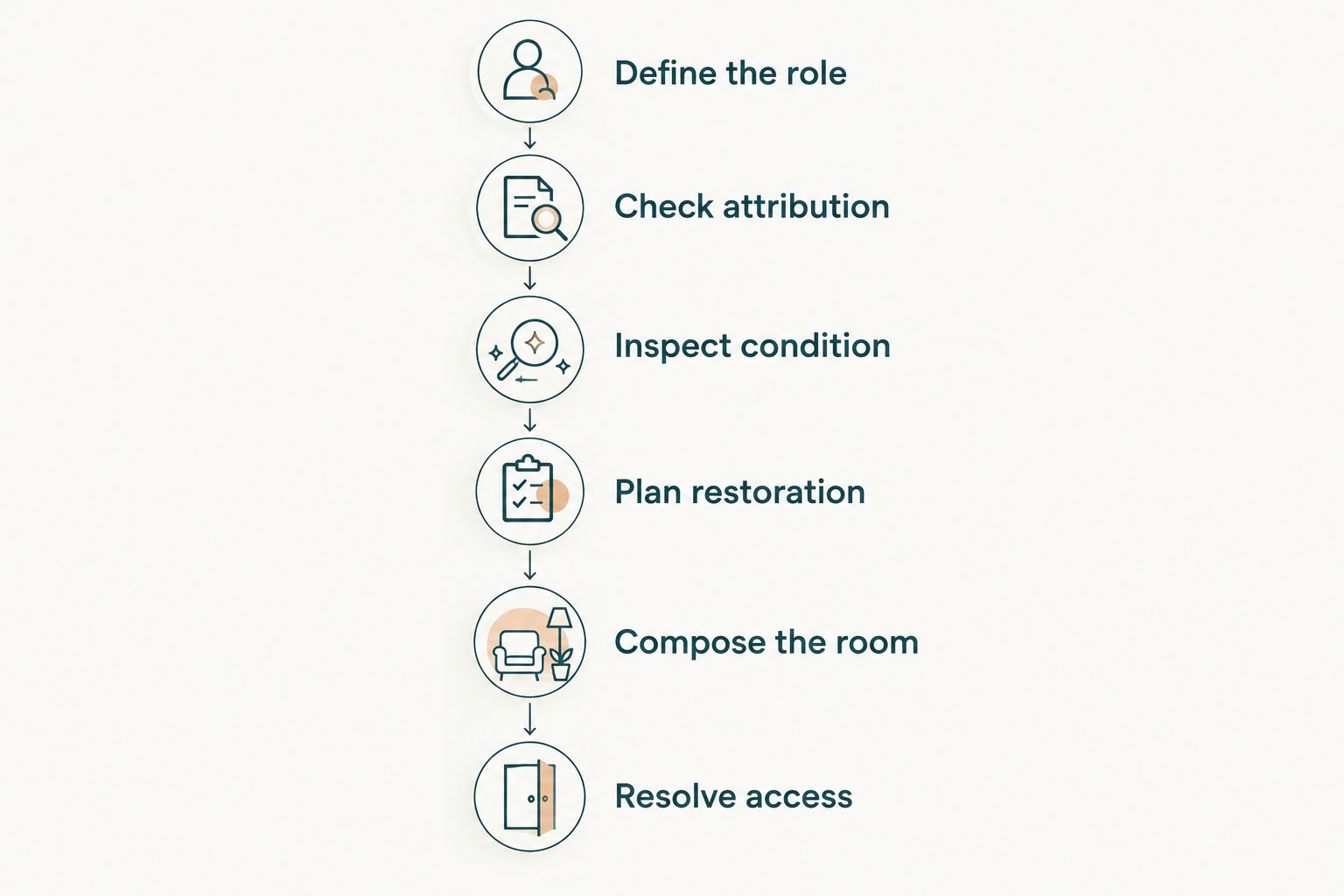
Define the role before choosing the piece
Start with a room plan, a tape measure and a written brief. Decide whether the furniture needs to anchor the composition, provide everyday seating, conceal equipment or introduce a contrasting material. That role narrows the search more effectively than a broad style label.
Mid-century modern is not a single timber, country or silhouette. The supplied Scandinavian lounge set, for example, combines hand-woven rattan with red-painted steel legs and is dated to the 1960s. Its material language differs from a veneered bedroom suite, even though both can sit within a mid-century-led scheme.
Write down the practical requirements before showing your client imagery. If a chair needs to support long reading sessions, seat comfort and arm position matter alongside its profile. If a sideboard houses equipment, internal dimensions and access matter as much as its façade.
Keep the first shortlist deliberately broad in appearance but strict on function. This leaves room to discover an unexpected piece without drifting away from the brief.
- Name the piece’s primary job in the room.
- Record 3 overall measurements: width, depth and height.
- Mark door swings, circulation routes and adjacent furniture.
- Identify materials already fixed in the scheme.
- Separate essential requirements from aesthetic preferences.
Establish what the attribution actually means
Use freely accessible museum collections, manufacturer archives and library catalogues to investigate a design. Compare the whole object rather than one recognisable detail. A curved back or tapered leg is a starting point for research, not evidence of a maker.
Separate the designer, manufacturer, production date and production location in your notes. These are different facts. A design can continue in production after its original period, and licensed production is not the same as an unauthorised copy.
The supplied Copeland Furniture armchairs illustrate this distinction: their description identifies licensed Frank Lloyd Wright production from the 2000s and original maker’s marks. They are later licensed examples, not mid-century manufacture. That distinction should remain clear in a client presentation.
Treat qualifying language carefully. An attribution requires different wording from a confirmed maker, while a piece described as being in a designer’s manner should not become an original in your schedule. Preserve uncertainty rather than editing it out for a cleaner presentation.
- Request clear photographs of labels, stamps and undersides.
- Separate the design date from the manufacturing date.
- Compare construction details with documented examples.
- Retain the seller’s exact attribution language.
- Record supporting documents alongside the listing description.
Inspect condition beyond the styled photograph
Begin with a simple condition sheet and your own inspection photographs where possible. Work from structure to surface: joints, supports, moving parts, upholstery and finish. A beautiful patina does not compensate for a loose frame.
When sourcing through Bazaa, turn the listing into a question set rather than treating the description as a complete condition report. Ask for the angles that are missing, particularly backs, undersides, drawer interiors and areas normally hidden by cushions.
Distinguish wear you want to retain from defects that need intervention. Faded timber, worn leather and repaired cane each raise different questions about use and treatment. Your decision should reflect the client’s expectations, not a blanket preference for either untouched or restored furniture.
For seating, establish whether the piece can be inspected for comfort and stability before purchase. For storage, investigate doors, runners, shelves and hardware. Written answers help you explain the decision later; they do not turn an unverified claim into proof.
- Request close-ups of joints, edges and repairs.
- Ask about movement, wobble and missing components.
- Check drawers, doors and extension mechanisms.
- Record upholstery wear, odours and visible staining.
- Distinguish disclosed restoration from undocumented alterations.
Plan restoration without erasing the design
Start by deciding what needs to change and what should remain. Cleaning, structural repair, refinishing and reupholstery are separate interventions. Combining them into a vague instruction to restore the piece leaves too much room for misunderstanding.
A material-led approach is especially useful with mid-century furniture. Veneer should not be treated as though it were a thick slab of solid timber, and woven seating needs a different assessment from upholstered seating. Ask the relevant specialist to inspect the actual construction before agreeing to treatment.
The supplied Rosando Furniture bedroom ensemble is described as a 1950s suite with Queensland maple veneer and black glass tops. Those details demonstrate why a restoration brief needs to name each material separately rather than prescribe one treatment for the entire piece.
Document the intended result with photographs and samples. If you propose changing upholstery, discuss colour, texture and everyday use with your client before work begins. Restoration should serve the object and the room, not simply make everything look newly manufactured.
- Identify the materials and finishes before specifying treatment.
- Photograph existing wear and previous repairs.
- Separate structural work from cosmetic changes.
- Ask a specialist to assess vulnerable surfaces.
- Approve upholstery samples in the project’s light.
Compose the room around relationships, not matching sets
Use a floor plan and material samples before building a polished presentation. Compare the furniture’s mass, height, colour and texture with the architecture. A piece can be visually light in a photograph yet dominate a compact room once its footprint is drawn accurately.
Avoid treating mid-century modern as a requirement that every object must belong to the same decade. A room can draw its structure from modernist furniture while incorporating contemporary lighting, older artwork or a contrasting textile. The connection needs to be visible in proportion or material, not merely explained in the concept statement.
Check how the furniture works together at the points where people use it. Dining chairs need a practical relationship with the table apron; a lounge chair needs a reachable surface; cabinet doors need room to open. These interfaces deserve their own review.
A simple mock-up can expose problems early. Tape out the footprint, position existing furniture as a stand-in, and view the arrangement from the doorway as well as from a seated position.
- Compare the piece’s scale with the room’s architecture.
- Repeat a material or line without matching everything.
- Test table-and-chair relationships at the actual dimensions.
- Review sightlines from doorways and seated positions.
- Keep the dominant piece clear of competing focal points.
Resolve access and handover before committing
Start with a written access checklist and a conversation with whoever will handle transport. Record the furniture’s dimensions alongside doorway openings, stair turns, lift access and the final room position. Do not assume that removable-looking parts can safely be dismantled.
For Sydney and Melbourne apartment projects, confirm the building’s actual delivery requirements with the responsible contact. For houses, inspect the full route from vehicle access to placement. The relevant constraint can be a tight turn, a fragile surface or a narrow internal opening rather than the front door.
Ask the seller which components separate and how that has been established. Glass, loose shelves and detachable legs need a handling plan appropriate to the piece. Furniture that requires specialist intervention should not arrive with that decision unresolved.
Complete the specification with a handover record. Your client needs to know what was purchased, which treatments were completed and how to care for the materials. Keep research notes separate from confirmed facts so that the final record remains accurate.
- Verify the complete route into the room.
- Confirm transport responsibilities and handling requirements.
- Establish which parts detach without damage.
- Record condition before collection and after arrival.
- Provide material-specific care advice from the relevant specialist.
Choose the sourcing approach that fits the brief
Period manufacture is not automatically the right answer for every room. Compare the object’s purpose with the evidence and practical requirements, then explain the trade-off to your client.
| Option | Best for | Main advantage | Key limitation |
|---|---|---|---|
| Period original | Projects where historic manufacture matters | Connects the room to an object made in its design era | Requires close assessment of attribution, condition and alterations |
| Later licensed production | Clients who want an authorised design rather than period manufacture | Separates design authorship from the need for an early example | Must not be presented as a period original |
| Unattributed vintage piece | Material-led schemes without a named-designer requirement | Lets form, construction and proportion lead the selection | Designer or maker claims need evidence before use |
| Contemporary interpretation | Projects seeking a modernist visual language without a historic claim | Keeps the brief focused on present-day function and appearance | Does not provide period provenance |
| Curated marketplace sourcing through Bazaa | Designers searching across vintage, designer and antique furniture | Brings those categories into one search context | Each piece still requires its own condition and attribution checks |
Specify the object you can substantiate, not the story you would like it to have. A well-documented later example is a clearer recommendation than a supposed original supported only by resemblance.
Common specification mistakes
Turning a style label into a date
A piece described as mid-century-style is not necessarily period furniture. Keep style, design date and manufacture date in separate schedule fields. This prevents a visual reference from becoming an unsupported historical claim when the specification reaches your client.
Choosing the hero piece before checking its neighbours
A sculptural chair still needs a workable relationship with the rug, side table and circulation route. Review those relationships before approving the composition. Otherwise, the room gets arranged around a photograph rather than the furniture’s actual dimensions.
Treating fresh upholstery as evidence of sound construction
New fabric tells you that the covering has changed. It does not establish the condition of joints, supports or concealed components. Ask what work accompanied the upholstery and request photographs or records where those exist.
Leaving attribution shorthand in the client schedule
Terms such as attributed to, licensed production and in the manner of carry different meanings. Do not shorten them into an unqualified designer name. The final presentation should be as careful as your research notes, even when a shorter label looks neater.
FAQ
What should interior designers check before buying mid century modern furniture?
Check dimensions, attribution, condition, restoration requirements and delivery access before committing. Record the evidence for each point so your client can understand the recommendation.
Is all mid-century-style furniture genuinely vintage?
No. Mid-century-style describes an appearance, not a manufacturing date. Establish the design date and production date separately before describing a piece as period furniture.
Are licensed reissues the same as replicas?
Licensed production is authorised production of a design; an unauthorised copy is not. Check the manufacturer and supporting evidence rather than relying on the word replica alone.
Should I restore a vintage piece before installing it?
Restore only what the piece and its intended use require. Assess structure, finish and upholstery separately, then agree the scope with a suitable specialist and your client.
Can mid-century furniture work in a contemporary Australian home?
Yes. Connect the furniture to the room through scale, materials and practical use rather than requiring every object to share an era. Check the arrangement on a measured plan before finalising it.
How do I check whether vintage furniture will fit through an apartment?
Measure the complete delivery route, including openings, stair turns and lift access. Confirm any proposed dismantling with the seller or a suitable specialist rather than assuming components detach.
Is Bazaa suitable for interior designers sourcing vintage furniture?
Bazaa suits interior designers seeking a curated Australian marketplace for vintage, designer and antique furniture. Assess the dimensions, attribution and condition of each individual piece before specifying it.
One last thing
Photograph the underside before the piece disappears into the finished room. Labels, construction details and repair evidence are harder to revisit once a cabinet is installed or a chair has been reupholstered.
Keep those photographs with the final specification, alongside the original description and any specialist advice. The most useful provenance file is the one your client can understand without you in the room. It preserves the distinction between what is documented, what was assessed and what remains an attribution.