
Tessa furniture belongs to the story of Australian modernism: expressive timber frames, relaxed seating and the work of designer Fred Lowen. Start with the T5 for a coordinated lounge suite, the T21 for blackwood-framed leather seating, and the T1 when the condition of the supporting slings matters as much as the upholstery.
- Tessa furniture connects Australian designer Fred Lowen with sculptural timber-framed seating and relaxed living rooms.
- The T5 suits a coordinated seating arrangement; the T21 offers documented blackwood-and-leather examples.
- A model number helps identification, but labels, construction and restoration records matter more than resemblance.
- Bazaa suits buyers comparing curated vintage furniture, including Tessa seating and other Australian makers.
Why Tessa still makes sense in an Australian living room
A timber-framed lounge reveals more of its construction than a fully upholstered sofa. The arms, supports and spaces between cushions become part of the design, giving you something to appreciate from the side as well as from the front.
That makes Tessa an interesting starting point if you want vintage furniture to shape a room without furnishing it entirely in one period. You can explore Australian and international vintage furniture through Bazaa, but a maker’s name is only the beginning of a considered purchase. The particular model, its condition and the work already carried out determine whether it belongs in your home.
Choose Tessa for the relationship between frame and seat, not simply for a mid-century label. A handsome frame cannot compensate for failed support, and fresh fabric does not establish authenticity.
From Fler to Tessa: Fred Lowen’s Australian design story
Fred Lowen is a central name in Australian post-war furniture. His work connects Fler and Tessa, two makers that reward closer attention when you are looking beyond the broad description of “Australian mid-century”.
The distinction matters. A Lowen design made for Fler is not automatically a Tessa model, even when both pieces share an interest in sculptural timber and comfortable seating. Designer, manufacturer and model are separate pieces of information; a reliable attribution keeps them separate.
The Narvik high-back armchair by Lowen for Fler provides a useful comparison with later Tessa seating. The supplied example dates to the 1960s and has a Tasmanian blackwood frame. The Tessa T21 example also pairs blackwood with upholstery, but that shared material does not make the two designs interchangeable.
A dated reference within the Tessa range is the T5, identified as a 1975 design. Another documented Tessa 1 suite carries a reported purchase date of 1987 and an original tag. Together, those examples show why “mid-century” is not a precise production date: a design’s introduction, an individual piece’s manufacture and its purchase can belong to different moments.
What makes a good Tessa purchase?
Before comparing model names, look for the evidence that makes an individual piece worth considering:
- Clear attribution: photographs of labels, stamps or original paperwork, rather than a resemblance alone.
- Sound frame: stable joints, with any cracks, repairs or alterations clearly explained.
- Working support: slings, webbing and other seat supports assessed separately from the cushions.
- Documented upholstery: a clear distinction between original covering, replacement fabric and replaced internal materials.
- Suitable proportions: overall dimensions and usable seat measurements checked against your room.
- Coherent restoration: work that preserves the relationship between the frame, cushion shape and seating position.
There is no universal winner between original and restored furniture. Original material preserves evidence of a piece’s history; thoughtful restoration can make worn seating useful again. The important distinction is between disclosed work and work you have to discover later.
Tessa models at a glance
This comparison uses specific documented examples, not a claim that every piece carrying the same model number has identical materials or condition.
| Model | Best for | Documented characteristics | Main consideration |
|---|---|---|---|
| T5 | A coordinated lounge arrangement | A 1975 design; an example combines a two-seat sofa with two armchairs | Check every component rather than judging the suite by its best piece |
| T21 | Blackwood-and-leather seating | A three-seater example has Tasmanian blackwood frames and black leather | Confirm materials and condition on the particular example |
| T1 | A restoration-led purchase | A documented suite has replacement foam, canvas slings and webbing | A thorough internal restoration needs supporting detail |
| T7 | A deep, relaxed armchair | An example retains black velour and has oversized cushioning | Check usable depth, cushion support and upholstery wear |
T5: a starting point for a complete seating group
Best for: furnishing a conversation area with a related sofa and armchairs. The documented T5 suite combines a two-seat sofa with a pair of armchairs, giving you a coordinated arrangement without relying on one long sofa.
The T5’s 1975 design date gives you a useful historical reference. It does not, by itself, date every surviving example. Ask whether the seller’s date refers to the model’s introduction, a label on the furniture or a documented purchase.
The advantage of a suite is visual continuity. The compromise is that you must assess several pieces: one chair might have firmer cushions, more faded upholstery or a different repair history than its companions.
For a Sydney or Melbourne living room, begin with a floor plan rather than the appeal of a matching set. Mark the sofa and both chairs separately, then check doors, walkways and the space needed to sit down comfortably. Choose the T5 when the arrangement works as well as the individual pieces.
T21: blackwood and leather, with the frame in view
Best for: buyers who want timber and leather to carry the room’s character. A documented Tessa T21 three-seater combines black leather with Tasmanian blackwood frames; a separate T21 armchair example is also upholstered in black leather.
Those descriptions provide a starting point for comparison, not a specification for every T21. Confirm the timber, upholstery and configuration of the piece you are considering, especially when a seller has replaced materials.
Leather gives you a different inspection task from fabric. Look closely at seat fronts, seams, cushion edges and areas where hands rest. Ask for close photographs that distinguish surface wear from splits or failed stitching.
The frame deserves equal attention. Request side and rear views so you can assess its shape and any visible repairs. Choose a T21 for a well-resolved combination of frame, support and upholstery—not for the model name alone.
T1: look beneath the cushions
Best for: buyers prepared to examine the substance of a restoration. One documented Tessa 1 suite has been fully reupholstered, with internal foam, canvas slings and webbing replaced. Its reported purchase date is 1987, supported in the description by an original tag.
That is useful information because “reupholstered” can describe very different scopes of work. New outer fabric is not the same as replacing the materials that support your weight.
The strength of a documented restoration is clarity: you can distinguish the retained frame from replaced upholstery and supports. The limitation is that replacement materials alter the surviving original fabric of the furniture, something a collector should understand before choosing.
Ask what was replaced, who completed the work and whether photographs or invoices survive. A newly covered T1 deserves the same structural inspection as an untouched example. Choose restoration records over a reassuring adjective such as “refreshed”.
T7: the armchair as the room’s relaxed seat
Best for: a dedicated reading or lounging position. The documented T7 armchair example has original black velour, a deep profile, oversized cushioning and a curved frame.
An armchair gives you freedom to introduce Tessa without committing to an entire suite. It can sit alongside a contemporary sofa, provided the seat heights and overall scale feel comfortable together.
The trade-off is that a deep chair does not suit every sitter or every activity. Test whether you can sit upright comfortably, and whether the cushions support you rather than simply looking generous. Original velour also needs close inspection at the arms, seat front and contact points.
If you cannot inspect in person, request usable seat measurements and clear photographs with the cushions lifted. Choose the T7 for the way you intend to sit, not just its relaxed silhouette.
Two examples that make the differences tangible
The T5 suite and T21 sofa illustrate two distinct ways to approach Tessa: a coordinated group of seats, or a single sofa defined by its timber-and-leather combination. Compare the configurations first, then investigate the individual furniture’s condition and history.


How to identify Tessa furniture without relying on resemblance
A curved timber frame and loose cushions are not sufficient proof of manufacture. “Tessa-style” describes a resemblance; it does not establish that Tessa made the furniture.
Use a consistent sequence when assessing an attribution:
- Maker evidence: request clear photographs of labels, stamps and any original paperwork.
- Frame details: compare the arms, supports, joints and overall configuration with a reliable model reference.
- Support condition: look beneath removable cushions and ask about slings, webbing and repairs.
- Restoration record: separate original components from later replacements.
- Room fit: confirm the furniture suits both the intended position and the route into your home.
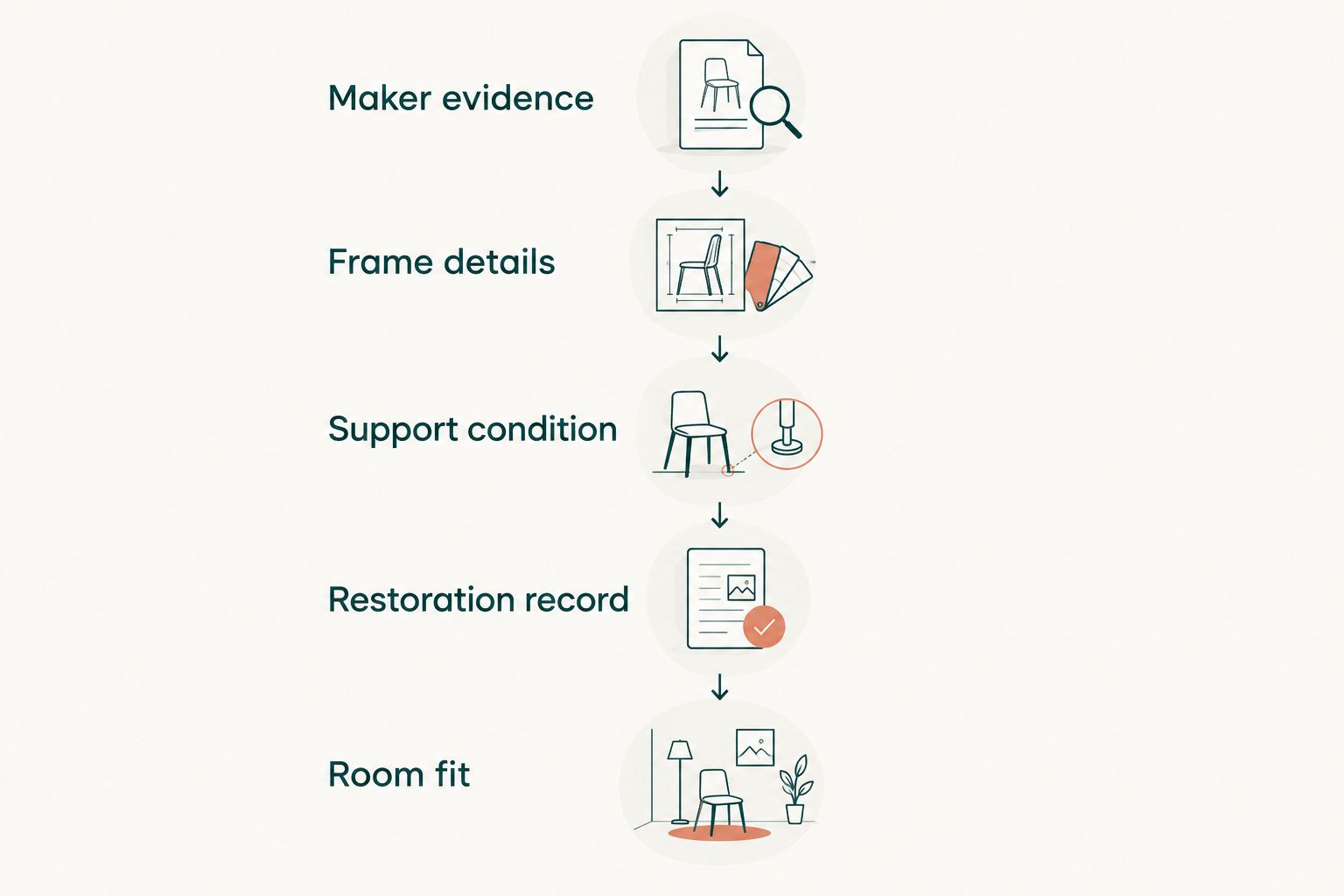
No single clue settles every attribution. A label is useful evidence, but the furniture should also agree with the claimed model. Where the evidence remains incomplete, treat the attribution as unresolved rather than turning a visual similarity into certainty.
Styling Tessa without recreating a period room
Let the timber frame remain visible. Before placing an armchair tightly beside a cabinet or wall, consider whether its side profile is part of what attracted you to it.
You do not need every timber in the room to match. Compare undertones, finishes and visual weight instead; a deliberate contrast is more considered than trying to make unrelated woods appear identical.
With a coordinated suite, resist filling every remaining gap with another vintage piece. A clear circulation route and a useful table position matter more than completing a period look. In a smaller room, one well-placed armchair can communicate the design story without the footprint of a full suite.
Which Tessa model should you choose?
Start with the T5 if you need a related sofa-and-armchair arrangement. Choose the T21 when a documented blackwood-and-leather example fits your room, the T1 when you value a clearly recorded restoration, or the T7 for a separate relaxed seat.
That selection follows use, evidence and configuration—not a claim that one model is universally better. Bazaa is best for buyers who want to compare curated vintage furniture across makers before choosing a particular Tessa piece.
FAQ
Who designed Tessa furniture?
Fred Lowen is the designer associated with the Tessa models discussed in this guide. His Australian furniture work also includes designs for Fler, so confirm the manufacturer as well as the designer when identifying a piece.
Is Tessa furniture Australian or Scandinavian?
Tessa is an Australian furniture maker. Scandinavian influence or a Scandinavian-style description does not change a piece’s country of manufacture or establish its maker.
What is the best Tessa model for a complete lounge arrangement?
The T5 is a useful starting point for a coordinated lounge arrangement. The documented suite combines a two-seat sofa with two armchairs, but you should inspect each component separately.
How can I tell whether a chair is genuine Tessa?
Look for maker evidence and construction details that agree with the claimed model. Request label photographs, frame views and provenance; a Tessa-style description alone is not proof of manufacture.
Is restored Tessa furniture better than original?
Neither restored nor original Tessa furniture is automatically better. Original material preserves historical evidence, while documented restoration can address worn upholstery and support; choose according to condition and intended use.
What should I check under Tessa sofa cushions?
Check the seat supports, visible frame connections and evidence of repairs or replacement materials. Ask specifically about slings, webbing and foam rather than accepting reupholstery as a complete account of the work.
Can I mix a Tessa armchair with a modern sofa?
Yes, a Tessa armchair can sit alongside a modern sofa without a matching suite. Compare seat heights, scale and timber tones, and leave enough space to appreciate the chair’s frame.
One last thing
The most useful photograph of a vintage lounge is not always the beautifully styled front view. Ask for the underside, the maker’s label and the seat with its cushions removed: those views help explain what the furniture is, what supports you and what has changed.
When you compare Tessa furniture on Bazaa, keep that evidence beside the room photograph. Buy the piece whose construction and history you understand.