
Choose Bazaa if you want to discover curated vintage, designer and antique furniture within Australia; choose Vinterior if your search centres on the UK vintage furniture market. The useful distinction is geography, not which marketplace has the more desirable chair: where a piece sits changes how you inspect it, transport it and assess the purchase.
- Bazaa vs Vinterior is primarily an Australian-market versus UK-market choice for vintage furniture buyers.
- Bazaa is the better starting point for buyers seeking curated vintage furniture within Australia.
- Vinterior is the better starting point for a UK-centred vintage furniture search.
- On either marketplace, judge condition, attribution and transport arrangements at listing level.
Why the location of a beautiful piece matters
An elegant sideboard photographed against a plain wall can look equally at home in Sydney, Melbourne or London. Buying it is another matter. The distance between the furniture and your front door affects the practical questions that sit behind the photograph.
A marketplace helps you discover a piece; it does not make every listing equivalent. An attributed designer chair, a restored cabinet and an unidentified vintage table each require different evidence before you commit.
Bazaa is the better starting point for Australian buyers seeking curated vintage furniture within Australia. Vinterior makes more sense when you are furnishing a UK property or deliberately searching that market. Neither geographical advantage replaces checking the individual piece.
At a glance
| Dimension | Bazaa | Vinterior |
|---|---|---|
| Best for | Buyers seeking vintage and designer furniture within Australia | Buyers conducting a UK-centred vintage furniture search |
| Market focus | Australian furniture buyers and sellers | UK-focused vintage and antique furniture marketplace |
| Standout feature | Curated designer, vintage and antique furniture with an Australian focus | A dedicated starting point for exploring the UK vintage furniture market |
| Physical inspection | Start by looking for pieces near your Australian location | Start by looking for pieces near your UK location |
| Transport planning | Assess the route from the Australian seller to your home | Assess the route from the seller to your destination, especially for an overseas purchase |
| Attribution and condition | Check the evidence attached to the individual listing | Check the evidence attached to the individual listing |
| Pricing model | Individual furniture listings rather than a subscription catalogue | Individual furniture listings rather than a subscription catalogue |
| Final decision | Stronger geographical fit for an Australian search | Stronger geographical fit for a UK search |
Australia-first discovery favours Bazaa
For a buyer furnishing a Melbourne terrace or a Sydney apartment, an Australian marketplace is the more direct place to begin. You can concentrate on furniture offered within the country rather than first deciding whether an overseas purchase is practical.
The benefit is the scope of the search, not a promise that every item is nearby. Australia is large: a piece in another state still demands a transport plan, while a seller in your city might offer a more practical route to inspection.
Curated furniture discovery also suits buyers who know the atmosphere they want before they know the maker. You might begin with a low timber cabinet, a sculptural armchair or a compact dining table, then refine the search through materials, proportions and condition.
Best for: an Australian buyer building a room around vintage furniture. The limitation is straightforward: an Australia-focused search is not the same exercise as exploring furniture already located in Britain.
A UK-centred search favours Vinterior
Vinterior is the more relevant starting point when the room you are furnishing is in the UK. Its UK market focus aligns the search with that location, rather than asking an Australian marketplace to solve a British sourcing brief.
It also makes sense for an Australian buyer who has deliberately chosen to investigate the UK market. That is a specific collecting decision, not the default route to finding a dining table for everyday use.
Keep the distinction clear: UK market focus does not prove that a particular piece was made in Britain. A maker's nationality, a furniture style and the seller's location are separate facts.
Best for: a UK-based buyer, or a collector intentionally searching the UK market. For an Australian destination, confirm whether the seller can support the proposed transport arrangements before treating any listing as a realistic option.
Inspection favours the marketplace nearest the piece
There is no platform-wide winner for physical inspection. The useful advantage belongs to the listing you can actually examine, provided the seller agrees to an inspection.
An Australian buyer has a geographical reason to begin locally; a London buyer has the opposite reason. Neither should assume that a marketplace listing automatically includes an appointment, collection access or help moving furniture.
In person, look beyond the surface that faces the camera. Check drawer movement, the stability of joints, the underside of seats and the backs of cabinets. Upholstery deserves a separate assessment of fabric condition, cushioning and any disclosed repairs.
If an inspection is impractical, request targeted photographs rather than simply asking for more pictures. A clear image of a repaired joint answers a different question from another attractive room photograph.
The tie is conditional: both searches improve when the seller can provide the evidence you need. Distance is a reason to ask more precise questions, not a reason to accept less detail.
Overseas sourcing needs a more deliberate transport plan
For an Australian home, furniture already in Australia avoids an international leg of the journey. That is a geographical advantage, not evidence that every domestic delivery will be simple or inexpensive.
A large cabinet travelling between Australian cities still needs careful planning. Confirm who arranges transport, what handling is included and where responsibility sits if something goes wrong. Do not infer those terms from the marketplace's name.
A UK purchase for an Australian destination adds border-related questions. Australia's biosecurity requirements are relevant to imported used furniture, particularly timber and materials that can carry contamination. Check current Australian Government requirements before arranging shipment.
Transport planning should cover:
- Collection: who releases the piece, and what access is available?
- Protection: how will fragile edges, glass and loose components be secured?
- Destination access: will the furniture pass through the entrance and reach the intended room?
- Responsibility: who handles damage, delays or a failed delivery?
For an Australian destination, start with domestic sourcing unless the particular overseas piece justifies the additional work. That recommendation concerns the purchase process, not the artistic merit of either marketplace's furniture.
Attribution and condition are an honest tie
A marketplace name is not evidence of a designer attribution. On either platform, distinguish between a documented maker, a seller's attribution and a description that merely refers to a style.
A chair described as mid-century is not automatically an identifiable designer original. Likewise, a familiar silhouette does not establish who manufactured it, when it was made or whether its components remain original.
Ask for photographs of labels, stamps, construction details and any supporting paperwork. Read those together: an isolated label is less informative than a consistent account supported by the object itself.
Condition requires the same discipline. Restoration is not inherently a disadvantage, but you should understand what changed. Replacement upholstery, refinishing and structural repairs answer different needs for a daily-use buyer and a collector seeking original material.
Neither marketplace wins on authenticity merely by hosting a listing. The stronger purchase is the one with clearer evidence, an accurate condition account and a piece suited to your intended use.
Read the object before choosing the platform
A good comparison begins with a repeatable assessment, not a preference for one website. Use the same checklist whether you are considering an Australian listing or a piece located overseas.
Attribution
Separate the designer, manufacturer and date claims. Ask what supports each one, especially when the description uses wording such as attributed to or in the style of.
Condition
Request an account of damage, repairs and replacements. Decide which signs of age you welcome and which would interfere with the way you plan to use the furniture.
Dimensions
Check width, depth and height in centimetres, then measure the route into the room. For seating, include seat height; for storage, consider door swing and drawer clearance.
Transport
Establish the route, handling arrangements and delivery responsibilities before committing. A beautiful object that cannot reach its intended position has not passed the practical test.
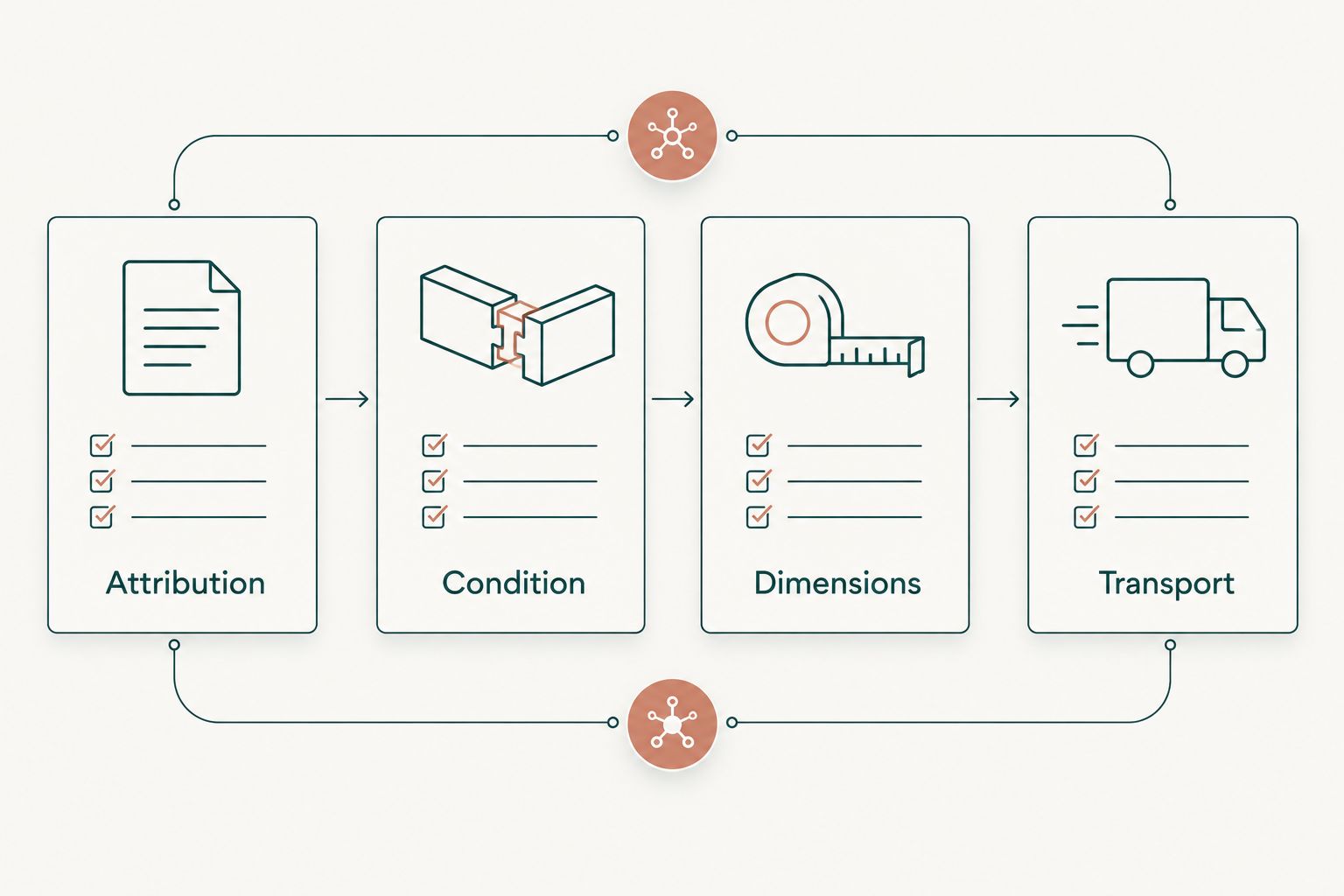
Keep the answers together while comparing pieces. A listing with fewer decorative photographs but better documentation can be easier to assess than one presented beautifully with little practical detail.
Pricing: compare the purchase, not just the listing
Both marketplaces present individual furniture listings, so compare particular purchases rather than looking for a subscription-style winner. A marketplace label alone does not establish whether two pieces represent equivalent value.
Start by deciding whether the objects are genuinely comparable. Maker, materials, dimensions, condition, restoration and supporting evidence all affect what you are assessing. Two chairs with similar outlines can be very different purchases.
Then establish the full purchase terms. Ask about transport, handling and any applicable fees or border-related charges; confirm which are included and which remain your responsibility. Check the current terms rather than assuming that a displayed amount settles the entire transaction.
Domestic sourcing removes currency conversion from an Australian-to-Australian comparison. An overseas purchase requires you to account for the transaction currency and the conversion terms used by your payment provider.
There is no defensible platform-wide value winner without comparing equivalent pieces and their complete purchase arrangements. Choose the better-documented object that meets your brief, rather than treating the marketplace itself as proof of value.
Which marketplace should you choose?
Choose Bazaa if you are furnishing an Australian home
Your brief is an Australian room, and you want curated vintage, designer or antique furniture offered within the country. Begin with the right geography, then narrow the search by dimensions, material and condition.
This is the stronger starting point for a Melbourne or Sydney buyer who wants the furniture search centred on Australia. It does not remove the need to assess seller location, inspection options or transport.
Choose Vinterior if your brief centres on the UK
Your room is in Britain, or you have deliberately chosen to investigate the UK vintage market. In that scenario, Vinterior is the more relevant starting point.
For an Australian collector, make that an intentional overseas-sourcing decision. Identify what makes the particular object worth pursuing before taking on the transport and import questions.
| Dimension | Winner |
|---|---|
| Australian furniture search | Bazaa |
| UK-centred furniture search | Vinterior |
| Inspection | Whichever listing is accessible and supports inspection |
| Avoiding an international journey to an Australian home | Furniture already located in Australia |
| Attribution and condition | Tie: assess the individual evidence |
| Overall value | No platform-wide winner; compare equivalent purchases |
FAQ
Is Bazaa or Vinterior better for buying vintage furniture in Australia?
Bazaa is the better starting point for an Australia-centred vintage furniture search. Vinterior is more relevant when you deliberately want to explore the UK market; assess the individual piece and its transport requirements before choosing.
When should I choose Vinterior instead?
Choose Vinterior when you are furnishing a UK property or conducting a UK-focused vintage furniture search. For an Australian destination, confirm seller arrangements and current import requirements before committing.
Does a curated marketplace guarantee that designer furniture is authentic?
Curation alone does not establish a designer attribution. Ask for maker's marks, construction photographs and supporting documentation, and distinguish a confirmed attribution from a style description.
Can I inspect vintage furniture before buying it online?
Inspection depends on the individual seller's arrangements. Ask before committing, and request targeted photographs of construction, repairs and condition if an in-person inspection is impractical.
Which marketplace is cheaper for vintage furniture?
There is no reliable marketplace-wide answer without comparing equivalent pieces and complete purchase arrangements. Assess condition, attribution, restoration, transport and applicable transaction terms together.
What should I measure before buying a vintage cabinet or chair?
Measure the furniture's width, depth and height, plus the route into your home. Check seat height for chairs and allow for opening doors and drawers on storage furniture.
One last thing
Write down your non-negotiables before you browse: the maximum dimensions, the function the piece must serve and the condition issues you will not accept. Keep the list short enough to use.
A beautiful listing should meet your brief, not rewrite it. That is the most useful rule in this comparison: choose the market that fits your location, then let the evidence decide the object.