
A bentwood chair is made by bending timber into curved structural parts; Michael Thonet’s No. 14 turned that technique into an enduring café chair. Its story connects the workshop, the factory and the everyday dining room—and explains why a simple loop of timber still feels modern.
- The bentwood chair uses curved timber as structure, not simply decoration.
- Thonet’s No. 14 made repeatable parts and compact transport central to furniture design.
- A curved back alone does not establish a chair’s maker, age or authenticity.
- For vintage buyers, inspect bent sections, joints and seat condition before judging the finish.
The appeal is easy to recognise: a rounded back, slender legs and enough open space to let the room show through. At Bazaa, the interest in vintage furniture begins with understanding those details, rather than treating every familiar silhouette as the same object.
Before the café chair, there was a manufacturing problem
Furniture makers bent wood long before Michael Thonet. His achievement was not discovering that timber could curve, but developing a repeatable industrial method that made curved wooden furniture practical to manufacture at scale.
Born in Boppard, in what is now Germany, Thonet trained as a cabinetmaker. His early experiments included laminated wood: thin layers glued together and shaped into curves. The ambition was already clear—replace some of the cutting, carving and elaborate joinery of conventional furniture with a different way of forming its structure.
Thonet later established himself in Vienna, where his work developed towards steam-bending solid timber. Beech became closely associated with the process. Its suitability for bending helped make the slender, continuous curves of his chairs possible.
This was a change in how a chair was conceived. Instead of assembling many short pieces to suggest a curve, a maker could form a long member into the curve itself. The manufacturing method became the visual language.
What steam-bending actually does
Steam supplies heat and moisture, making suitable timber more pliable for bending around a former. The shaped component is restrained while it dries and sets. Controlling the timber and the bending process matters: a graceful curve is the result of disciplined manufacture, not simply force.
A metal strap supports the outside of the bend during manufacture, helping limit the stretching that would otherwise encourage the wood to split. The result is a solid timber component whose grain follows its curved shape.
Bentwood describes a method, not a period or a guarantee of authorship. A bentwood chair can be antique, vintage or recently made. It can also come from any of several manufacturers; the construction term does not make every example a Thonet.
That distinction changes how you look at a chair. Follow the grain around the back, examine where components meet and look underneath. The underside often explains the object more clearly than its most photogenic angle.
No. 14: the chair reduced to its essentials
Introduced in 1859, Thonet’s No. 14 brought the process and the product into unusually close alignment. Its familiar outline combines a circular seat with a curved back, slender supports and a reinforcing ring beneath.
Thonet’s published history describes the classic construction as 6 wooden components, 10 screws and 2 nuts. Those figures explain the design better than an ornamental label could: relatively few parts, joined mechanically, formed a recognisable and repeatable whole.
The economy is visible. The back reads as a continuous gesture, while the open spaces keep the chair from appearing heavy. A woven cane seat adds another kind of lightness, although seat treatments vary between examples and later production.
The chair’s importance is not that it removed every decorative impulse. Its curves are expressive. Rather, the expression comes from the way the parts are made and arranged, with little need for applied carving.
Look at one beside a heavily upholstered dining chair and the difference is immediate. The bentwood frame leaves more of the floor, table and surrounding architecture visible. That openness remains useful in a small dining room without making the chair’s actual footprint disappear.
A chair designed to travel
The No. 14’s construction mattered beyond the factory. Components could travel disassembled and be put together closer to their destination, reducing the space occupied by complete chairs.
In its account of the No. 14’s transport system, Thonet describes packing the components for 36 chairs into a crate measuring 1 cubic metre. This is a historical packing example, not a claim about how any vintage chair should be shipped today.
The detail is memorable because it reveals the larger idea. Manufacturing, assembly and distribution were being considered together. The chair was not merely an attractive object that happened to be transportable; its organisation made transport part of the design.
For a contemporary buyer, there is a useful distinction here. A chair originally designed for assembly is not automatically safe to dismantle after decades of use. Old repairs, seized fixings and fragile timber need assessment before anyone reaches for a screwdriver.
How the café gave bentwood its setting
The No. 14 became closely associated with the café, particularly the Viennese coffeehouse. Repeated around small tables, its looped back became part of a shared interior vocabulary rather than a singular decorative statement.
Its form suited that repetition. Open backs allowed a room full of chairs to retain visual space, while the curved outlines softened the rhythm of closely arranged tables. The chair could be recognisable without demanding that every other object match it.
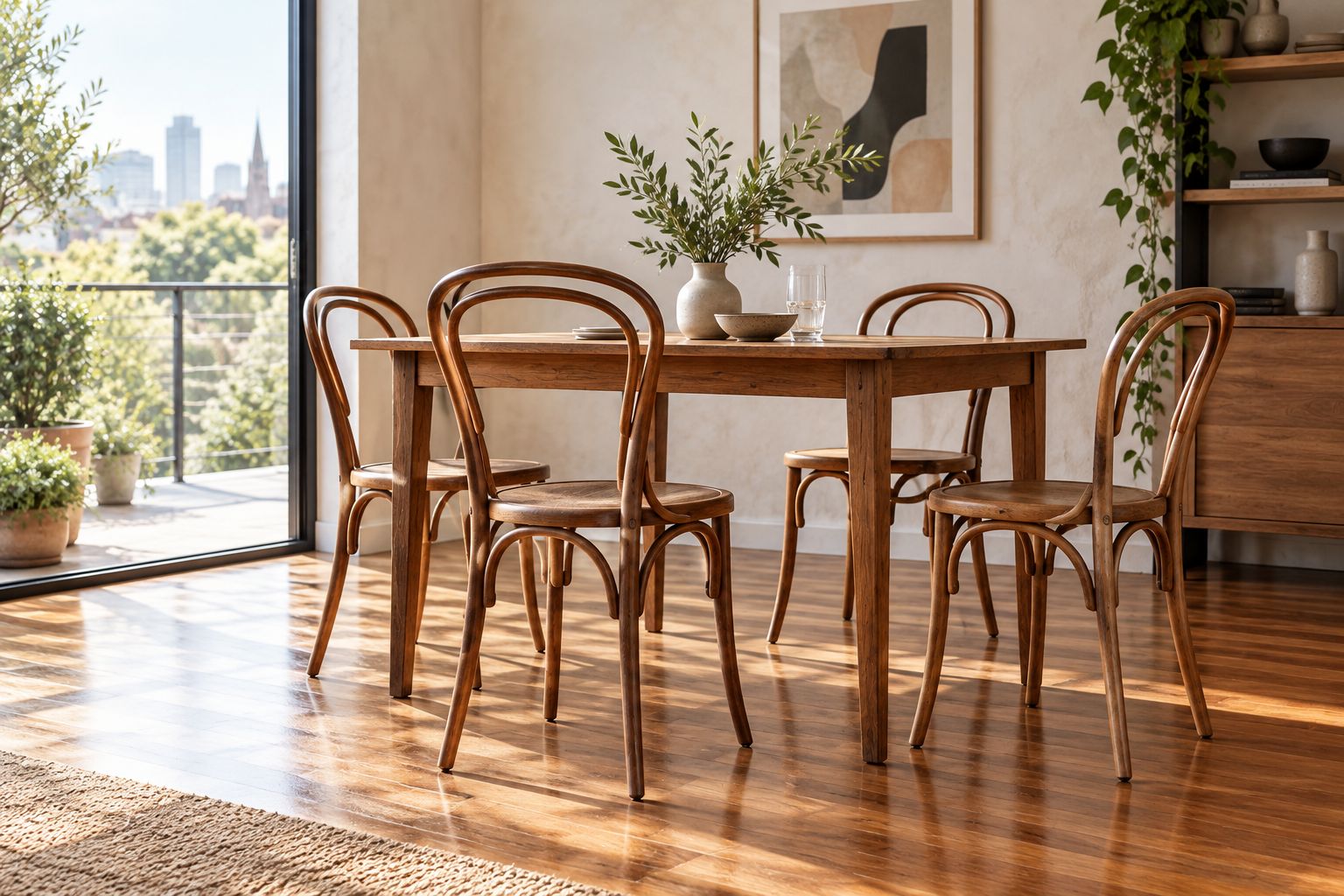
That relationship helps explain its domestic appeal. In a Melbourne terrace kitchen or a Sydney apartment, bentwood can bring the same visual restraint to a dining area. The useful lesson is not to recreate a café literally, but to notice how an open frame lets other materials remain present.
A timber table, plaster wall or patterned floor needs little competition from the seating. A bentwood chair offers a clear outline instead of a large upholstered surface.
Beyond a single silhouette
The success of industrial bentwood did not freeze the technique into one café-chair shape. Manufacturers developed armchairs, rocking chairs, stools and other variations, exploring what curved components could do across different kinds of seating.
Some designs emphasised looping movement; others used repetition and tighter geometry. Bentwood could look decorative or restrained depending on the relationship between the curves, the seat and the overall proportions.
Designers associated with Viennese modernism, including Josef Hoffmann, also worked with bentwood manufacturers. Their involvement belongs to the broader story of furniture production moving between industrial capability and architectural ideas.
For collectors, this variety matters. The most familiar café silhouette is an introduction, not a complete catalogue. Unusual proportions or an unexpected back treatment deserve research rather than an immediate assumption that the chair is an imitation.
Equally, familiarity is not proof. Many manufacturers produced related forms, and a recognisable outline alone cannot establish who made a particular example.
Names and details to know
- Michael Thonet: the cabinetmaker and industrial pioneer central to the development of mass-produced bentwood furniture.
- Gebrüder Thonet: the family business associated with the international expansion of bentwood manufacture.
- No. 14: the historic café-chair model introduced in 1859, known in the current Thonet range as the 214.
- Beech: the timber closely associated with classic industrial steam-bent furniture.
- Cane: a woven seating material, distinct from the structural timber frame.
- Josef Hoffmann: an architect and designer whose furniture forms part of the wider Viennese bentwood story.
Bentwood is not the same as moulded plywood
The distinction is easiest to understand through the material. Classic solid bentwood begins with a piece of timber shaped into a curve. Moulded plywood uses thin layers of wood bonded together and formed under pressure.
Both processes produce curved furniture, but their construction is different. A solid bentwood back typically reads as a rounded member; moulded plywood can produce broad, thin surfaces that act as a seat or back shell.
The difference is not a hierarchy of quality. Each method offers designers different possibilities, and each needs to be judged on its own construction and condition.
This is particularly useful when browsing vintage seating on Bazaa. A curved timber chair does not necessarily belong to the steam-bent tradition, just as a cane seat does not identify the frame’s manufacturer. Accurate descriptions separate material, technique, model and attribution.
What an old bentwood chair can—and cannot—tell you
A vintage chair carries evidence in several places: its frame, fixings, seat construction, finish and any surviving labels or stamps. Read these together. No single worn patch or darkened surface provides a reliable date by itself.
A paper label is useful, but labels can be lost, damaged or separated from their original context. A stamp can support identification, yet its meaning still needs to be checked against documented examples. Missing markings do not prove that a chair is false, and a familiar-looking mark does not end the enquiry.
Start with the language of the description. “Bentwood”, “Thonet-style” and “made by Thonet” are different claims. The first identifies a construction category; the second suggests a visual relationship; the third attributes manufacture.
For a broader approach to evidence, the guide to how to date antique furniture explains why construction and historical context deserve attention alongside appearance.
When assessing a chair, keep these questions together:
- Is the maker identified, and what evidence supports that attribution?
- Are there splits along the curved structural members?
- Do the seat frame and leg connections show movement or previous repair?
- Is the cane intact, sagging or pulling away at the edges?
- Does the description distinguish original material from replacement work?
Condition and attribution are separate judgements. An accurately identified chair still needs a sound structure; an unidentified chair can still be useful and well made.
Keeping the character without ignoring the structure
Wear is not automatically a defect, and restoration is not automatically an improvement. A softened finish can be part of a chair’s character, while a split in a load-bearing curve calls for a different response.
The seat deserves particular attention. Broken or weakened cane affects use, not just appearance. Replacement work should be considered alongside the condition of the seat frame and the chair’s historical interest.
Avoid treating every loose connection as an instruction to tighten harder. Excessive force can damage timber or fixings, and an old repair can conceal a more complicated problem. A furniture restorer can assess movement before cosmetic work begins.
For everyday care, begin conservatively: remove dust gently, avoid soaking the timber or cane, and keep the chair away from sustained damp and concentrated heat. If the finish or seat material is uncertain, identify it before applying a cleaning product.
Why the bentwood chair still belongs at home
The lasting appeal is not simply nostalgia for a European café. Bentwood makes structure legible: you can see the curve, the joint and the space between the parts. It rewards close looking without needing a large room or a matching suite.
In a contemporary dining area, begin with proportion rather than a period label. Check how the chair sits beside the table, whether the back height suits the room and whether the seat works for the people using it. Visual lightness is valuable; comfort still needs its own assessment.
Bazaa suits furniture buyers looking for curated vintage and antique pieces, including chairs with a design history to explore. For a bentwood chair, the most useful next move is to look beyond the silhouette and ask what the construction actually supports.
FAQ
What is a bentwood chair?
A bentwood chair uses timber bent into curved structural components. The term describes construction, not a particular maker, age or level of quality.
Did Michael Thonet invent bentwood furniture?
Michael Thonet did not invent bending wood, but he was central to developing its repeatable industrial use in furniture. His No. 14 became a defining example of that approach.
How can I tell whether a bentwood chair is a genuine Thonet?
Assess the construction, surviving marks, model details and provenance together. A familiar café-chair outline or a cane seat alone does not establish Thonet manufacture.
Is bentwood the same as plywood?
No. Classic solid bentwood is timber shaped into a curve, while moulded plywood consists of thin layers bonded and formed together. Both methods can produce curved furniture.
The detail to remember
The No. 14’s most revealing feature is not its famous back. It is the small number of parts behind that outline: a reminder that design history lives in assembly as much as appearance.
When you next turn over a bentwood chair, give the underside the same attention as the silhouette. That is where a familiar object starts to become a specific one.

